Purpose-Built for Hazardous Inspection
The EX-1 is not primarily a research, entertainment or high-speed robot dog. It is a specialised industrial platform designed for fire-emergency scenes, chemical depots, petrochemical plants, refineries and LNG facilities. Its four-legged design allows it to move across broken ground, stairs and slopes that may be difficult for conventional wheeled inspection robots.
A 30 kg continuous walking load gives operators room to carry inspection sensors, communications equipment or other mission hardware. Supported payloads include a dual-light PTZ, methane detector, voice-intercom module and speaker. This makes the EX-1 suitable for gathering information, checking for methane and supporting remote communication before personnel enter an area.
The main benefit is reduced exposure rather than the elimination of risk. The robot can be sent ahead to inspect or assess a scene while operators remain farther away, but safe deployment still requires route planning, reliable communications, sufficient battery reserve, a recovery procedure and approval under the facility’s hazardous-area rules.
Mobility, Perception and Remote Operation
The EX-1 combines a 12-DoF legged body with joints rated for up to 500 Nm of maximum torque. Galileo specifies a maximum speed of 1.0 m/s, a 30° climbing capability, 25 cm stair and obstacle capability, and a 30 cm ditch-crossing width. These figures favour controlled movement and stability over speed.
For environmental perception, the current specification lists one LiDAR and two depth cameras. Galileo says its sensor-fusion system supports autonomous navigation, path planning, dynamic obstacle avoidance and target tracking. Operators can also control the robot remotely using the supported explosion-proof tablet and 4G connection. Ethernet is provided for external communication and system integration.
The lithium battery stores 2,160 Wh and provides a stated endurance of two hours. Actual mission time will depend on terrain, carried equipment, communications use, temperature and operating pattern. Secondary development is supported, allowing integrators to build specialised inspection functions around the platform.
Understanding the Explosion-Proof Claim
Galileo publishes an Ex IIB T4 Gb explosion-proof marking for the EX-1. Broadly, this marking communicates the intended explosive-gas group, temperature classification and equipment-protection level. The facility’s hazardous-area specialist should verify that the certification matches the actual zone, gases, ambient conditions and local regulations.
The complete deployed configuration matters as much as the robot body. Cameras, gas sensors, radios, connectors, robotic arms and other payloads must not invalidate the required protection. Charging and battery replacement should also occur only in locations and under procedures permitted by the supplied documentation. IP67 is an ingress-protection rating and is separate from explosion protection; neither rating should be used as a substitute for the other.
EX-1 Compared with Galileo’s Other Robot Dogs
Galileo’s base quadrupeds address distinctly different workloads. The comparison below excludes the faster C1-W, E1-W and S1-W wheel-legged versions.
Model: C1
Weight: 22 kg | Continuous walking load: 12 kg | Speed: 0–3 m/s | Endurance: 3–5 hours | Protection: IP67 joints
Best suited for: Research, education, development and light-duty inspection where compact size and portability matter.
Model: E1
Weight: 52 kg | Continuous walking load: 30 kg | Standing load: 100 kg | Speed: 0–3.5 m/s | Endurance: 2.5–4.5 hours | Protection: IP67
Best suited for: General industrial inspection requiring stronger mobility, longer endurance and a medium-sized payload platform.
Model: S1
Weight: 118 kg | Continuous walking load: 100 kg | Standing load: 170 kg | Speed: 0–3.5 m/s | Endurance: 3.5–5 hours | Protection: IP67
Best suited for: Heavy material transport, large inspection equipment and demanding industrial or emergency-response missions.
Model: EX-1
Weight: 120 kg | Continuous walking load: 30 kg | Speed: 1.0 m/s | Endurance: 2 hours | Protection: IP67; published Ex IIB T4 Gb marking
Best suited for: Hazardous industrial inspection where verified explosion-protection suitability is more important than maximum speed, load or endurance.
In short, choose the C1 for compact development and light work, the E1 for mainstream industrial inspection, the S1 for heavy loads, and the EX-1 when the application requires a purpose-built hazardous-environment configuration that matches the site’s certification requirements.
 Research
  Industrial
  Consumer
  Social
  Service
  Assistive
  Medical & Healthcare
  Emergency Response
  Building & Construction
  Other Infrastructure
  Transport
  Arts & Entertainment
  Agriculture & Forestry
  Law & Order / Security
  Other
Other 

 Galileo (Tianjin) Technology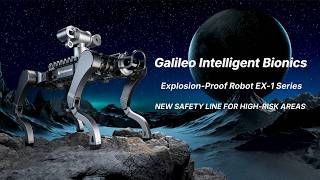



 Emergency & Disaster Response Robots
  View All
  Linkedin
 in Sydney, Australia.
Share