Two Humanoids, Different Ways to Move
KUAVO 5 and KUAVO 5-W are fifth-generation humanoid robots developed by China's Leju Robotics, with a focus on bringing embodied AI and robotic manipulation into practical environments. Both combine articulated arms, environmental sensors, and onboard computing, but they take different approaches to mobility.
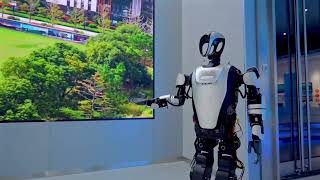
KUAVO 5 is the bipedal version, standing 1.73 metres tall and weighing 63.5 kg. With articulated legs, a movable waist, and configurable robotic hands, it is designed to explore human-like walking and coordinated physical tasks. It also provides a platform for developing advanced humanoid motion control and manipulation.
KUAVO 5-W takes a different approach. Instead of legs, it uses a wheeled mobile base, making it particularly suitable for movement across relatively flat environments such as factories and warehouses. It also offers an adjustable working height and longer advertised battery endurance.
Both versions are intended to support robotic learning and increasingly complex physical tasks, giving researchers and industrial developers different options for exploring how humanoids can operate in real-world settings.
From Factory Floors to Research Labs
Industrial manufacturing is a major focus of the KUAVO 5 series. With articulated arms, configurable grippers, and intelligent sensing, the robots can be used to develop applications involving material handling, object manipulation, and manufacturing support. KUAVO 5-W's wheeled design is particularly relevant to tasks that involve repeated movement between workstations on flat factory floors.
Research and education are also important applications. Universities, research centres, and robotics developers can use the platforms to investigate humanoid locomotion, robotic manipulation, autonomous navigation, and embodied AI. Their software interfaces and robot-learning resources also support data collection and the development of new control algorithms.
Leju additionally presents applications in commercial guidance, outdoor patrol, and home services. These scenarios can involve activities such as guiding visitors, interacting with people, or performing object-handling demonstrations.
Although both platforms are designed for a wide range of tasks, practical autonomy and performance depend on the installed software, training, hardware configuration, and working environment.
What Makes the KUAVO 5 Series Special
One of the most interesting things about the KUAVO 5 series is its combination of advanced humanoid manipulation and two different mobility designs.
The legged KUAVO 5 offers the flexibility of a bipedal robot, making it useful for studying movement in environments designed around humans. Its articulated legs and waist allow researchers to explore walking, balancing, bending, and coordinated whole-body movements.
KUAVO 5-W, meanwhile, focuses more on the practical advantages of wheels. Its mobile base supports omnidirectional movement, while its adjustable body structure offers a wide working range. This makes the wheeled version particularly interesting for repetitive industrial tasks where stable movement and extended operation matter more than human-like walking.
Another important feature is the platform's development ecosystem. Through Leju's robotics software and LeTools framework, developers can collect robot data, train learning-based policies, and deploy them to compatible hardware.
Rather than representing two completely different robot concepts, KUAVO 5 and 5-W show how a shared humanoid approach can be adapted to different working environments.
Quick Model Comparison
Model: KUAVO 5 (Legged)
Height: 1,730 mm | Weight: 63.5 kg | DoF: 41 (including dexterous hands) | Single-Arm Payload: 5 kg | Advertised Endurance: ≥2 hours
Best suited for: Bipedal locomotion research, embodied AI development, whole-body manipulation, robot learning, and industrial task demonstrations.
Model: KUAVO 5-W (Wheeled)
Height: 2,000 mm (extended) | Weight: 156 kg (headline configuration) | DoF: 40 (including dexterous hands) | Single-Arm Payload: 5 kg | Advertised Endurance: ≥8 hours
Best suited for: Industrial material handling, mobile manipulation, factory automation research, robot learning, and tasks requiring longer operation on relatively flat surfaces.
KUAVO 5 Series vs Other Leju Humanoid Robots
KUAVO 5 and 5-W build on Leju Robotics' earlier humanoid platforms, including KUAVO 4 and KUAVO 4Pro. Compared with KUAVO 4Pro, which has a documented height of 1.66 metres and weight of 55 kg, the newer KUAVO 5 is taller and heavier, with a redesigned platform, an additional waist joint, and a stronger emphasis on industrial manipulation. KUAVO 5-W takes the fifth-generation design in a different direction by offering wheeled mobility and longer operating endurance for flat industrial environments.
Leju also develops smaller humanoid robots, including ROBAN 2 and the AELOS series. These are more closely associated with research, education, and programming activities, while the full-size KUAVO 5 series is aimed at more demanding robot-learning, manipulation, and industrial application development.
 Research
 Industrial
 Consumer
 Social
 Service
 Assistive
 Medical & Healthcare
 Emergency Response
 Building & Construction
 Other Infrastructure
 Transport
 Arts & Entertainment
 Agriculture & Forestry
 Law & Order / Security
 Other

 Leju Robotics



 Research Robots
 View All
 Linkedin
 in Sydney, Australia.
Share