A Humanoid Built for Research and Real-World Tasks
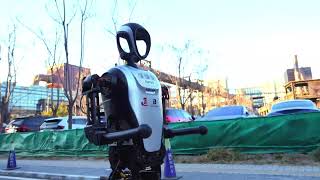
KUAVO 4Pro is a full-size humanoid robot developed by China's Leju Robotics to explore how robots can move, interact, and perform useful tasks in human environments. Standing 1.66 metres tall and weighing approximately 55 kg, it combines a bipedal body with articulated arms, intelligent sensors, and onboard computing.
One of its standout features is its configurable design. Depending on the version, KUAVO 4Pro can use five- or seven-degree-of-freedom arms, with options for two-finger grippers or more advanced dexterous hands. This allows researchers and developers to explore different types of manipulation, from basic grasping to more involved object-handling tasks.
The robot also supports dynamic movements such as walking and running. With depth cameras, LiDAR, and other sensing systems, it provides a platform for studying robot perception, movement, and interaction with the surrounding environment.
Applications: From Robotics Labs to Commercial Services
KUAVO 4Pro is designed for a range of research and practical application scenarios. In research laboratories and universities, it can serve as a platform for developing humanoid locomotion, robot manipulation, perception systems, and embodied artificial intelligence.
Robot learning is another important application. Researchers can use KUAVO 4Pro to collect real-world movement and manipulation data, study imitation learning, and develop algorithms that help robots perform physical tasks.
Beyond research, Leju presents commercial service applications, including exhibition hall guidance, shopping assistance, and interactive explanations for visitors. Its humanoid appearance, sensing capabilities, and potential integration with AI systems make it suitable for developing human-robot interaction applications.
Industrial manufacturing is another area of exploration. KUAVO 4Pro can be used to develop and evaluate object-handling, manipulation, and other robot-assisted workflows. The level of autonomy and practical deployment capability depends on the software, hardware configuration, and specific task.
What Makes KUAVO 4Pro Special
What makes KUAVO 4Pro interesting is its combination of humanoid mobility, configurable manipulation hardware, and a development environment for embodied AI.
Unlike robots designed around a single fixed task, KUAVO 4Pro provides a platform for experimenting with different robot behaviours and applications. Developers can work with articulated arms, robotic hands, sensors, and motion-control interfaces to investigate how a humanoid can interact with physical objects and its surroundings.
Another advantage is its support for real-world robot learning. Leju has developed data-collection and robot-learning resources around the KUAVO platform, helping researchers study how physical demonstrations can be used to train robotic systems.
The result is a humanoid that serves both as a research platform and as a foundation for exploring practical applications. While it is not a fully independent general-purpose worker, KUAVO 4Pro offers useful capabilities for advancing robot learning, manipulation, and human-centred robotics.
KUAVO 4Pro vs Other Leju Humanoid Robots
KUAVO 4Pro sits within Leju Robotics' wider humanoid lineup, which includes both newer full-size robots and smaller bipedal platforms. Compared with the earlier KUAVO 4 generation, the 4Pro is a more developed configuration aimed at research and application development. Meanwhile, the newer KUAVO 5 introduces a fifth-generation platform with 41 degrees of freedom and a stronger emphasis on dynamic movement and industrial manipulation. Leju also offers KUAVO 5-W, which combines a humanoid upper body with a wheeled mobile base rather than bipedal legs. This makes it better suited to certain indoor industrial applications where wheeled mobility and longer operating time are useful.
Leju's smaller robots serve different purposes. ROBAN 2 is a medium-sized bipedal humanoid, while the AELOS range consists of compact bipedal robots oriented toward education, programming, and interactive learning. KUAVO 4Pro therefore occupies a different position in the lineup: a full-size humanoid platform aimed primarily at advanced research, robot learning, manipulation, and the development of practical humanoid applications.
 Research
 Industrial
 Consumer
 Social
 Service
 Assistive
 Medical & Healthcare
 Emergency Response
 Building & Construction
 Other Infrastructure
 Transport
 Arts & Entertainment
 Agriculture & Forestry
 Law & Order / Security
 Other


 Leju Robotics



 Research Robots
 View All
 Linkedin
 in Sydney, Australia.
Share