Applications: From Industrial Tasks to Research
The ROBOTERA L7 is designed to combine impressive humanoid movements with practical manipulation capabilities. Its potential applications cover manufacturing, logistics, robotics research, and interactive demonstrations.
In logistics, Robotera has demonstrated tasks such as intelligent sorting and barcode scanning. In manufacturing-related demonstrations, the L7 has shown object handling, assembly operations, and the use of tools for screw fastening. Its dual 7-DoF arms and dexterous hands allow it to manipulate objects in ways that resemble human arm and hand movements.
The L7 is also suitable as a research platform for studying humanoid locomotion, whole-body control, teleoperation, and embodied artificial intelligence. Researchers can use humanoid platforms like the L7 to collect movement and manipulation data and investigate more capable robotic behaviours.
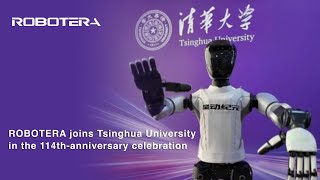
Beyond practical work, Robotera has showcased the L7 performing dance movements and dynamic jumps, demonstrating the versatility of its motion-control system.
These examples reflect Robotera's published demonstrations and intended application areas, rather than verified large-scale autonomous deployment.
What Makes the ROBOTERA L7 Special
One of the L7's standout characteristics is its combination of whole-body agility and dexterous manipulation. While walking on two legs is already a demanding robotics challenge, the L7 is also designed to perform dynamic movements such as running, jumping, and turning while maintaining coordinated control of its body.
Standing 1.71 metres tall, the robot features 55 degrees of freedom, including two 7-DoF arms and two 12-DoF dexterous hands. Its XHAND1 hands provide independently actuated finger movements, enabling more varied grasping and manipulation than simple robotic grippers.
Its high-performance joints are another important feature. Robotera specifies peak knee torque of 400 N·m and a running speed of 4 m/s, highlighting the robot's focus on dynamic mobility.
The L7 brings these movement capabilities together with binocular vision, 3D LiDAR, and a combined dual-arm payload of 20 kg. This makes it an interesting platform for exploring how humanoid robots can combine mobility and useful physical work.
Flexible Design for Humanoid Robotics Development
Another interesting aspect of the ROBOTERA L7 is its relationship with Robotera's M7 upper-body humanoid platform. Rather than requiring researchers to work exclusively with a complete walking humanoid, Robotera also provides an upper-body configuration centred on manipulation and control.
The M7 platform allows research to focus on arm movements, dexterous hands, perception, and teleoperation without introducing the additional challenges of bipedal locomotion. Robotera also promotes transferring capabilities developed with the upper-body platform to the full L7 configuration.
For researchers, this approach offers flexibility when developing and testing manipulation tasks, gathering training data, or experimenting with whole-body robotic control.
The full L7, meanwhile, adds the legs and balancing capabilities needed to explore mobile humanoid operation. It is intended for scenarios requiring both locomotion and physical interaction with objects.
Together, these configurations illustrate Robotera's approach to developing humanoid robots that can support different stages of research and application development.
ROBOTERA L7 vs Other Robotera Humanoids
Robotera offers different humanoid platforms, each designed around different movement and manipulation requirements. The L7 is its full-size bipedal humanoid, standing 171 cm tall with 55 degrees of freedom and a combined dual-arm payload of 20 kg. Unlike the ROBOTERA Q5, which moves using a wheeled base, the L7 can walk, run, and jump on two legs. The Q5 features 44 degrees of freedom and a combined dual-arm payload of 10 kg, with a greater emphasis on wheeled mobility, manipulation, and interactive service applications.
The ROBOTERA M7, on the other hand, is an upper-body humanoid platform rather than a complete walking robot. With 43 degrees of freedom including its dexterous hands, it focuses on manipulation, teleoperation, and research. It shares important upper-body design features with the L7 but does not provide the L7's bipedal locomotion.
Robotera also developed the earlier STAR1 humanoid, a 171 cm bipedal robot with 55 degrees of freedom. The L7 was introduced in 2025 as a new-generation model with an emphasis on combining dynamic movement and practical work. Although the two share several headline specifications, Robotera has not clearly established the precise engineering relationship between them.
ROBOTERA L7 and M7: Shared Upper-Body Design
An interesting feature of the ROBOTERA L7 is that it shares its upper-body design with the ROBOTERA M7, a separate humanoid platform focused on manipulation and research. Both robots feature the same upper-body architecture, including two 7-DoF arms and two 12-DoF dexterous hands. The main difference is that the M7 is an upper-body robot mounted on a stationary support, while the L7 adds two articulated legs for walking, running, and other dynamic movements. As a result, the M7 has 43 degrees of freedom, compared with the L7's 55.
This shared design provides flexibility for researchers and developers. The M7 allows them to focus on tasks such as object handling, assembly, teleoperation, and AI model training without the added complexity of bipedal locomotion. Robotera also promotes an upgrade path from the M7 to the full L7, including the transfer of learned manipulation capabilities. This makes the two platforms complementary: the M7 focuses on upper-body manipulation, while the L7 combines those capabilities with full-body mobility.
 Research
 Industrial
 Consumer
 Social
 Service
 Assistive
 Medical & Healthcare
 Emergency Response
 Building & Construction
 Other Infrastructure
 Transport
 Arts & Entertainment
 Agriculture & Forestry
 Law & Order / Security
 Other


 ROBOTERA


 Multi/General-Purpose Robots
 View All
 Linkedin
 in Sydney, Australia.
Share