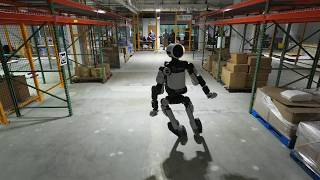
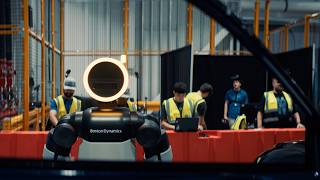
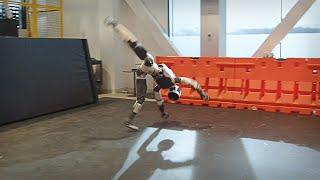
Image/s credit: Boston Dynamics.

Boston Dynamics Atlas Electric Humanoid Robot

company logo for Boston Dynamics Boston Dynamics

Country: United States of America

Year: 2024

Summary

Boston Dynamics' all-electric Atlas brings advanced mobility, powerful lifting, and intelligent autonomy to industrial tasks, with a focus on manufacturing and logistics.

Status: In development

Operation: Autonomous, Teleoperation

Robot Type / Domain: Multi/General-Purpose, Industrial

Tasks: Part Sequencing, Material Handling, Pick-and-Place, Machine Tendings

More Videos

Play video background image - video 2
Atlas Showing its Moves on Wheels
Play video background image - video 2
Lean More About Atlas and the Future
Play video background image - video 2
Reinforcement Learning and Atlas for Great Movements

Learn More

From Hydraulic Pioneer to Electric Industrial Humanoid

Atlas has come a long way since Boston Dynamics introduced its original hydraulic-powered humanoid in 2013. That earlier Atlas became famous for its remarkable mobility, demonstrating everything from walking over challenging terrain to backflips and parkour. But it was primarily a research platform rather than a commercial robot.

In April 2024, Boston Dynamics retired hydraulic Atlas and introduced a completely new, all-electric version. The redesign aimed to deliver greater strength, dexterity, and flexibility while preparing Atlas for practical applications beyond the research lab.

Another major milestone arrived in January 2026, when Boston Dynamics unveiled the production version of electric Atlas at CES. Unlike its research-focused predecessor, this generation was developed specifically for industrial environments, incorporating features for reliability, safety, maintenance, and integration into existing workplaces.

With its human-scale form, 56 degrees of freedom, and powerful lifting capabilities, Atlas represents Boston Dynamics' transition from demonstrating advanced humanoid mobility to developing robots that can perform useful work in factories and warehouses.

Applications: From Manufacturing to Logistics

Atlas is being developed primarily for industrial applications where robots need to move around human-designed workplaces and manipulate objects of different shapes, sizes, and weights.

One of its first practical applications is automotive part sequencing. This involves picking components from storage containers and arranging them in the correct order before they reach an assembly line. Although the task might sound straightforward, it requires Atlas to identify, grasp, lift, transport, and position different parts while navigating a changing environment.

Atlas robots are undergoing training for such activities at Hyundai Motor Group's Robotics Metaplant Application Center in Georgia, USA.

Beyond part sequencing, Boston Dynamics identifies material handling, machine tending, and order fulfilment as applications for Atlas. Its combination of bipedal mobility, dexterous manipulation, and substantial lifting capacity is intended to help it work in spaces and workflows originally designed for people.

Hyundai Motor Group plans to introduce Atlas into automotive manufacturing operations from 2028, beginning with parts sequencing, before expanding into more complex tasks such as component assembly around 2030.

These wider deployments remain planned developments rather than established large-scale operations.

Intelligent Software and the Path to Commercialisation

Atlas is more than a powerful humanoid body. Its software plays an important role in helping the robot perceive its surroundings, manipulate objects, and carry out tasks autonomously.

Boston Dynamics has developed Atlas to combine advanced movement and manipulation capabilities with AI-based learning. The robot supports autonomous operation, VR teleoperation, and tablet control, allowing different approaches to training and operating the system.

Atlas also integrates with Boston Dynamics' Orbit software, which supports fleet monitoring and connections to industrial systems such as Manufacturing Execution Systems (MES) and Warehouse Management Systems (WMS). Boston Dynamics has designed the platform so that tasks learned by one Atlas can be transferred to other robots in a fleet.

In January 2026, Boston Dynamics also announced a partnership with Google DeepMind to explore integrating Gemini Robotics foundation models into Atlas, with the goal of expanding its ability to learn and perform industrial tasks.

The production version entered manufacturing in 2026, with initial deployments allocated to partners including Hyundai and Google DeepMind. Atlas is still in an early commercialisation and industrial training phase, with broader customer adoption expected to develop gradually as its capabilities are validated in real workplaces.

DO NOT COPY

Do Not Copy

Brief History

Boston Dynamics was founded in 1992 as a spin-off from the Massachusetts Institute of Technology (MIT). In 2013, the hydraulic-powered Atlas program was first introduced to the public as a part of a DARPA-funded initiative. Atlas was never commercialized but it was a humanoid robot that kept shocking robotic lovers around the world time after time with its great capabilities such as running, doing backflips, and even engaging in parkour. The hydraulic Atlas was retired in April 2024 and replaced with its better and more powerful successor, the electric-powered Atlas, designed with commercialization in mind. 

Top 5+ Qualities (by addoobot)

What we find to be the top qualities of all-electric Atlas by Boston Dynamics:

  • Powerful Lifting: Handles up to 50 kg instantaneously and 30 kg on a sustained basis, making it suitable for demanding industrial handling tasks.
  • Advanced Mobility: Features 56 degrees of freedom and an extensive range of joint motion, allowing movement beyond typical human joint limitations.
  • Intelligent Autonomy: Designed to perform industrial tasks with minimal supervision while adapting to changing environments.
  • Dexterous Hands: Uses articulated hands with tactile sensing in the fingers and palms to support object manipulation.
  • Self-Swapping Batteries: Can autonomously replace its battery in approximately three minutes to support continuous operation.
  • Human-Scale Design: Built to operate in existing industrial workstations and use equipment designed for human workers.
  • Flexible Operating Modes: Supports autonomous operation, VR teleoperation, and tablet-based control.
  • Industrial-Ready Design: Features IP67 protection, modular components, and an operating temperature range of -20°C to 40°C.
  • Connected Fleet Intelligence: Uses Boston Dynamics' Orbit software to support industrial system integration, robot monitoring, and sharing learned tasks across Atlas fleets

Fun Corner (by addoobot)

Future of yoga classes
A meme about a robot vs humans in yoga class

Technical Specifications

• Maximum Weight Capacity (Instant): 50 kg

• Sustained Weight Capacity: 30 kg

• Battery Runtime with Heavy Lifting: 2 hours

Max. Size:  1900H (mm)

Max. Size:  74.803H (in)

Max. Payload: 20 kg (per arm)

Max. Payload: 44.092 lbs (per arm)

Weight: 90 kg

Weight: 198.416 lbs

Battery Operated? Yes

Average Runtime: 4 hr(s)

Battery Recharge Time: 1.5 hr(s)

Locomotion Type: Legs/Walking

DOFs (total): 56

IP Rating: IP67

Operating Temperature: -20 ℃ to 40 ℃

Operating Temperature: -4.000 ℉ to 104.000 ℉

Sensors: Tactile sensing in fingers and palms

Actuators: Continuous rotation capability of joint movement

Battery: Autonomous battery swapping | 3 minutes battery swap time | Charging power requirements: 110 V (220 V optional)

No more specs to show.

Please visit the official website for more accurate, up-to-date, and complete information on this post. Visit Website   External Link Icon

Disclaimer: For informational purposes only. The provided data and/or content are intended as references and may contain errors. We appreciate your help in maintaining accuracy; if you spot any errors, please notify us. For the most reliable and up-to-date information, kindly refer to the official website. By using addoobot and its contents and services, you agree to our Terms and Conditions, Privacy Policy, and Cookie Policy.

Thumbs Down Icon Thumbs Up Icon
0 1 2 3 4 5 6 7 8 9 10

Select appealing qualities


 0 Comments

Sign in to comment, reply, and more

No Comments Yet

Be the first to share your thoughts!