A humanoid built for strength and agility
The ENGINEAI T800 is a full-size humanoid robot developed to combine powerful physical performance with advanced mobility and manipulation. Standing approximately 1.73 metres tall, it features a human-like body with articulated arms, legs, neck and waist. Its joint actuators can deliver up to 450 N·m of peak torque, helping the robot perform fast and demanding movements.
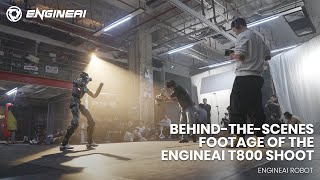
ENGINEAI has demonstrated the T800 performing martial arts-style movements, including punches, kicks and coordinated sequences inspired by capoeira. The company has also demonstrated dynamic running and other complex motions. These performances highlight the robot's mechanical capabilities and motion control, although they do not necessarily demonstrate autonomous decision-making or practical task performance outside controlled settings.
A key part of the design is the combination of powerful joint actuators and active cooling. The T800 incorporates cooling around its leg joints to help manage the heat produced during intensive movements. Together with its aluminium and titanium alloy structure, this makes it a platform designed for demanding physical motion rather than simply slow walking demonstrations.
More than just walking: seeing and handling the world
The T800 is also designed for applications that require sensing and object manipulation. Development-oriented configurations incorporate binocular cameras and LiDAR to collect information about the surrounding environment. These sensors can support tasks such as mapping, navigation, obstacle detection and perception-driven control.
Another important feature is the availability of articulated robotic hands. The Pro and Max configurations offer seven degrees of freedom per hand, providing more movement options for grasping and manipulating objects. ENGINEAI also describes tactile sensing and force-control features for its dexterous hands, with the aim of supporting both firm grasping and more delicate operations.
These capabilities are relevant to applications such as handling objects in warehouses, assisting with manufacturing processes and performing service-related tasks.
Four versions for different needs
ENGINEAI advertises four T800 editions, allowing customers and developers to select different levels of articulation, computing and sensing.
- Basic: 25 DoF body, five-axis arms, no dexterous hands, Orin NX 16 GB and basic camera sensing.
- Open Source / Developer: 25 DoF body, enhanced computing, development support and LiDAR-equipped configurations.
- Pro: 43 total DoF including dexterous hands, seven-axis arms, LiDAR and AGX Orin 64 GB.
- Max: 46 total DoF including hands, additional waist articulation and 5G connectivity.
The most noticeable difference is between the versions with and without dexterous hands. The Basic and Developer models have five degrees of freedom in each arm and do not list the seven-degree-of-freedom robotic hands found on the Pro and Max.
The Pro adds more articulated arms and hands, giving developers greater flexibility when exploring manipulation tasks. The Max goes a step further by incorporating additional waist movement, increasing the robot's overall articulation.
Research, development and real-world applications
ENGINEAI positions the T800 for a range of industrial and commercial applications, including warehouse logistics, hotel services, retail assistance and human-robot collaboration.
Its full-size design, mobility and articulated arms make it a potential platform for developing material handling and service workflows. For example, researchers can investigate how a bipedal robot navigates human environments, approaches objects, manipulates them and moves between workstations.
ENGINEAI also provides development documentation and robot software resources. Its published resources include ROS 2-related interfaces, robot description files and native control software supporting T800 motion states such as standing, walking and dancing. These are useful foundations for robotics research, although the availability of particular functions depends on the robot edition and software compatibility.
The robot's substantial weight and powerful joint actuators also mean that safety needs particular attention when operating it around people. The manufacturer's product information explicitly warns users to maintain safe distances from the robot's high-power drive system.
How does the T800 differ from other ENGINEAI humanoids
The T800 is ENGINEAI's more powerful full-size humanoid platform, while its other robots focus on different aspects of locomotion, research and human-like movement.
- SA01: A simpler, 12-DoF bipedal development platform focused on legged robotics rather than a complete humanoid body.
- PM01: A compact, approximately 140 cm humanoid with 24 DoF in its 2026 editions, designed for dynamic movement and robotics development.
- SE01: A full-size, 170 cm humanoid with 32 DoF, particularly focused on producing smooth, natural human-like walking movements.
- T800: A 173 cm high-performance humanoid with up to 46 DoF including hands, 450 N·m peak joint torque, and configurations intended for demanding industrial and commercial development.
The PM01 is smaller and lighter, making it an attractive platform for education, locomotion experiments and general humanoid development. Its compact size contrasts with the heavier T800, which is designed around greater joint torque and more demanding physical movements.
The SE01 is closer to the T800 in size, but its distinguishing focus is natural human-like walking. ENGINEAI developed the SE01 with particular attention to fluid walking patterns and human-like body proportions.
The T800 builds on ENGINEAI's humanoid development experience with a stronger emphasis on physical performance, advanced manipulation and industrialisation. Its high-torque joints, articulated-hand configurations and onboard computing make it a more capable hardware platform for exploring demanding applications, although successful deployment still depends heavily on the software and task requirements.
 Research
 Industrial
 Consumer
 Social
 Service
 Assistive
 Medical & Healthcare
 Emergency Response
 Building & Construction
 Other Infrastructure
 Transport
 Arts & Entertainment
 Agriculture & Forestry
 Law & Order / Security
 Other


 ENGINEAI




 Research Robots
 View All
 Linkedin
 in Sydney, Australia.
Share