What Makes the ENGINEAI PM01 Special
The ENGINEAI PM01 is a compact humanoid robot that packs some impressive movement capabilities into a relatively small body. Standing around 1.4 metres tall, it features 24 degrees of freedom, including a highly flexible waist that can rotate up to 320°. This gives the robot plenty of flexibility to perform complex movements and maintain dynamic balance.
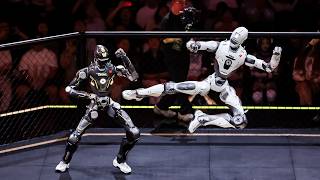
One of the PM01's biggest highlights is its agility. ENGINEAI has demonstrated the robot walking with a human-like gait, running, dancing, and even performing a front flip. These demonstrations show the capabilities of its mechanical design and motion-control technology, although they do not necessarily represent everyday autonomous operation.
What makes the PM01 particularly interesting is that it is also designed as an open development platform. Researchers and developers can explore new algorithms, experiment with locomotion and balance control, and build their own robotic applications. This combination of advanced movement and development flexibility makes the PM01 an interesting platform for exploring humanoid robotics.
Applications: Research, Education and Development
The PM01 is primarily designed for robotics research, education, and development, rather than being a finished household assistant. Its open platform gives universities, laboratories, and developers opportunities to work on humanoid locomotion, balance control, perception, and artificial intelligence.
For example, researchers can use the robot to test walking algorithms, investigate how humanoids respond to changes in their environment, or experiment with reinforcement learning. ENGINEAI also provides development resources that support training robotic behaviours in simulation and deploying them on physical hardware.
The PM01 can also serve as an educational platform for students learning about robotics, mechanical systems, programming, and motion control. Its cameras, computing hardware, and optional LiDAR provide opportunities to develop vision-based and navigation applications.
Although ENGINEAI also identifies industrial applications as a target, the PM01 should mainly be viewed as a flexible research and development platform. Applications requiring reliable industrial operation would need their own validation and safety assessment.
Open Development and Intelligent Motion Control
Another interesting aspect of the PM01 is ENGINEAI's approach to software development. Rather than limiting users to predefined movements, the company provides resources for developing and testing custom robot behaviours.
The available tools include ROS 2 interfaces, simulation environments, and code for training and deploying motion-control algorithms. Developers can work with existing movement commands or explore more advanced control approaches. ENGINEAI's official development resources also include reinforcement-learning frameworks, allowing researchers to experiment with how robots learn and perform different movements.
The PM01's onboard computing includes an NVIDIA Jetson Orin NX module, providing processing capabilities for AI and vision-based applications. It also uses cameras positioned at the head and waist to help gather information about its surroundings.
This makes the PM01 particularly interesting for developers who want to go beyond watching a humanoid perform impressive tricks and actually experiment with the technology behind its movements.
PM01 vs Other ENGINEAI Humanoid Robots
ENGINEAI has developed several robotic platforms with different purposes. The PM01 sits between the company's simpler bipedal research platform and its larger, full-size humanoids.
SA01A: simpler, highly expandable bipedal research platform with 12 degrees of freedom, primarily focused on legged robotics development rather than a complete upper-body humanoid.
PM01A: compact full-body humanoid with 24 degrees of freedom, prioritising dynamic movement, flexibility and development accessibility.
SE01A: taller, approximately 170 cm full-size humanoid with 32 degrees of freedom, particularly focused on natural, human-like walking and a more human-proportioned design.
T800A: larger, approximately 173 cm humanoid with substantially higher joint torque, reaching up to 450 N·m. It targets more physically demanding applications and offers configurations with more advanced hand and arm articulation.
The PM01's main appeal is the combination of its smaller size, advanced mobility and developer-friendly approach. Compared with the SA01, it provides a complete humanoid body with arms, a movable waist and additional interaction capabilities. Compared with the larger SE01 and T800, it offers a more compact platform for studying humanoid movement and experimenting with robotics technologies.
The SE01 places greater emphasis on natural human-like movement and full-size proportions, while the T800 offers considerably higher joint torque and more advanced configurations for demanding applications. The PM01 is therefore particularly interesting as a flexible platform for research, teaching and humanoid software development.
 Research
 Industrial
 Consumer
 Social
 Service
 Assistive
 Medical & Healthcare
 Emergency Response
 Building & Construction
 Other Infrastructure
 Transport
 Arts & Entertainment
 Agriculture & Forestry
 Law & Order / Security
 Other


 ENGINEAI


 Multi/General-Purpose Robots
 View All
 Linkedin
 in Sydney, Australia.
Share