What Makes the FANUC CRX Series Special
The main strength of the FANUC CRX Series is that it tries to combine two things that do not always come together: industrial-grade reliability and beginner-friendly collaborative automation. FANUC is already well known for industrial robots, but the CRX Series is designed to be more approachable for companies that may not have deep robotics experience.
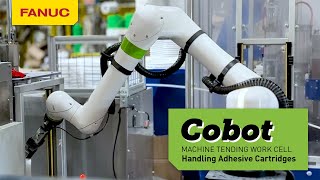
The CRX models are built around simple setup, easy programming, and flexible deployment. Features such as hand guidance, drag-and-drop programming, and support for approved end-of-arm tools make the robots easier to integrate into real workflows. This is especially useful for small and medium-sized manufacturers that want to automate repetitive or physically demanding work without building a large traditional robot cell from scratch.
The wide model range is also a major advantage. Instead of forcing users into one payload or reach class, FANUC offers compact, mid-range, long-reach, and heavy-payload CRX options. That makes the series easier to compare against other cobot families.
Applications
The FANUC CRX Series is mainly designed for industrial automation tasks where manufacturers want a robot that is easier to deploy than a traditional industrial robot but still strong enough for real production work. Typical applications include machine tending, material handling, part transfer, assembly, picking and packaging, inspection, dispensing, sealing, sanding, screwdriving, welding, and palletizing.
The smaller models, such as the CRX-3iA and CRX-5iA, are better suited to light handling, inspection, small assembly, tool positioning, and flexible high-mix tasks. The CRX-10iA and CRX-10iA/L are useful mid-range options, especially when a balance of payload, reach, and flexibility is needed. The CRX-20iA/L and CRX-30iA are better suited to heavier jobs such as palletizing, larger part handling, welding, and machine tending.
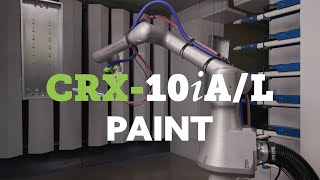
There are also specialist versions, including food-grade CRX models for food and beverage environments, and the CRX-10iA/L Paint for painting, coating, and related finishing applications.
FANUC CRX Series Model Comparison
Model: CRX-3iA
Payload: 3 kg | Reach: 692 mm | Robot Weight: 11 kg | Repeatability: ±0.02 mm
Best suited for: Very light handling, inspection, small assembly, welding support, and portable or space-limited setups.
Model: CRX-5iA
Payload: 5 kg | Reach: 994 mm | Robot Weight: 25 kg | Repeatability: ±0.03 mm
Best suited for: Small part handling, assembly, picking, packaging, and inspection tasks.
Model: CRX-10iA
Payload: 10 kg | Reach: 1,249 mm | Robot Weight: 40 kg | Repeatability: ±0.04 mm
Best suited for: General material handling, machine tending, assembly, dispensing, and light industrial automation.
Model: CRX-10iA/L
Payload: 10 kg | Reach: 1,418 mm | Robot Weight: 40 kg | Repeatability: ±0.04 mm
Best suited for: Longer-reach applications, welding, machine tending, picking, packing, and part transfer.
Model: CRX-20iA/L
Payload: 20 kg | Reach: 1,418 mm | Robot Weight: 41 kg | Repeatability: ±0.04 mm
Best suited for: Higher-payload handling, palletizing, machine tending, welding, and larger workpiece handling.
Model: CRX-30iA
Payload: 30 kg | Reach: 1,756 mm | Robot Weight: 135 kg | Repeatability: ±0.05 mm
Best suited for: Heavy handling, palletizing, larger parts, welding, and more demanding industrial cobot applications.
Note: The CRX-30iA can also reach up to 1,889 mm when operating in its 25 kg payload mode.
Quick Buying/Comparison Note
For light and flexible tasks, the CRX-3iA and CRX-5iA are the easiest models to think about first. For general-purpose cobot automation, the CRX-10iA and CRX-10iA/L are likely the most balanced options. For heavier production work, palletizing, and larger workpieces, the CRX-20iA/L and CRX-30iA are the stronger choices.
As with any collaborative robot, the robot itself is only one part of the system. End-of-arm tooling, safety assessment, workcell layout, payload shape, cycle time, and the application environment all matter when choosing the right CRX model.
 Research
  Industrial
  Consumer
  Social
  Service
  Assistive
  Medical & Healthcare
  Emergency Response
  Building & Construction
  Other Infrastructure
  Transport
  Arts & Entertainment
  Agriculture & Forestry
  Law & Order / Security
  Other
Other 
 FANUC Corporation


 Multi/General-Purpose Robots
  View All
  Linkedin
 in Sydney, Australia.
Share