Image/s credit: NIRYO.

Niryo Ned2 Robot Arm

company logo for NIRYO NIRYO

Country: France

Year: 2022

Summary

A compact 6-axis educational robot arm designed for hands-on learning in robotics, programming, automation, AI and industrial-style applications.

Status: Commercially available

Operation: Collaborative, Tethered

Robot Type / Domain: Research, Educational

Tasks: Robotics & programming education, pick-and-place, material handling, sorting, assembly and automation training, computer vision, inspection exercises

Technical Specifications

Max. Reach: 490 mm

Max. Reach: 19.291 in

Payload: 0.3 kg

Payload: 0.661 lbs

Max. Payload: 0.3 kg

Max. Payload: 0.661 lbs

Pose Repeatability: ± 0.5 mm

Pose Repeatability: ± 0.020 in

Weight: 7 kg

Weight: 15.432 lbs

Battery Operated? No, Tethered

Arm Type: Articulated, Collaborative

Number of Axes: 6 DoF

IP Rating: N/A

Mounting: Floor, Other

Footprint: 200 mm × 200 mm (length × width)

Footprint: 7.874 in × 7.874 in (length × width)

Operating Temperature: 5 ℃ to 45 ℃

Operating Temperature: 41.000 ℉ to 113.000 ℉

Software: NiryoStudio is the main programming environment, with support for visual Blockly programming and Python. Niryo also provides compatibility or integration options for ROS, ROS 2, MATLAB, RoboDK, OpenCV and TensorFlow-based

Controller & Computing: Built around a Raspberry Pi 4 with a 64-bit ARM V8 processor and 4 GB RAM.

Material: Aluminium and injection-moulded ABS-PC

Power supply: External AC/DC adapter accepting 100–240 V AC, 50/60 Hz, with 12 V and 5 V outputs to the robot.

Data Transmission / Communication: 2.4 GHz and 5 GHz Wi-Fi, 1 Gb/s Ethernet and USB 2.0/3.0 connectivity. Niryo documentation also lists Modbus TCP/TCP-IP communication.

No more specs to show.

Top 5+ Qualities (by addoobot)

What we find to be the top qualities of the Niryo Ned2 cobot:

  • Accessible Programming: Learners can begin with visual Blockly blocks and progress to Python, ROS and other advanced development tools.
  • Industrial-Style Six-Axis Movement: Provides hands-on experience with the motion and control principles used by larger articulated robot arms.
  • Easy Manual Teaching: FreeMotion allows users to move the arm by hand, while the Save button makes recording positions straightforward.
  • Flexible Tool Ecosystem: Compatible grippers, a vacuum pump, an electromagnet, a vision system and conveyors support a wide range of exercises.
  • Strong Connectivity: Wi-Fi, Gigabit Ethernet, USB, analogue and digital I/O make it possible to connect sensors, computers, PLCs and accessories.
  • Open and Expandable Platform: Open-source technologies, accessible APIs and downloadable 3D files support custom research and development projects.
  • Designed for Learning Spaces: Its compact desktop format, intuitive LED feedback and quiet stepper technology suit classrooms and teaching laboratories.

More Videos

Play video background image - video 2
Example Application: Tool Changing by Ned2
Play video background image - video 2
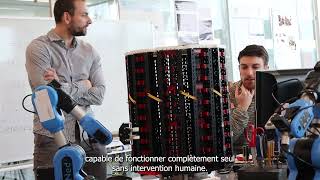
Niryo Ned2 for Teaching
Play video background image - video 2
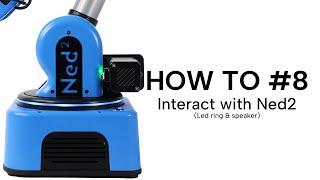
Learn to Interact with Ned2

Learn More

Applications

Ned2 is primarily a hands-on education and research platform rather than a production robot. Students can use it to study robot kinematics, coordinate systems, trajectory planning, programming, sensors and basic automation. Common exercises include moving small objects, sorting items, performing pick-and-place routines and simulating light assembly, packaging or palletising processes.

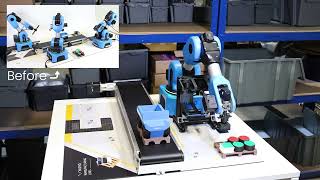
With Niryo’s optional conveyor, infrared sensor and Vision Set, Ned2 can recreate a small automated production line. For example, students can program the system to detect an arriving object, identify its colour or shape, pick it up and place it in the appropriate location. Several robots can also be combined to explore multi-robot coordination, communication and production-flow concepts.

These capabilities make Ned2 suitable for secondary schools, vocational education, universities, engineering laboratories and research projects involving robotics, computer vision, artificial intelligence or human–robot interaction. Its 300 g payload means applications should use small and lightweight objects.

Programming and Learning Experience

Ned2 supports a gradual learning pathway. Beginners can use NiryoStudio’s Blockly interface to assemble programs from visual blocks, operate the robot directly and save positions without first learning a conventional programming language. The integrated Python environment then allows students to create more advanced logic, functions and automated sequences.

More experienced users can work through PyNiryo, the Python ROS wrapper, ROS or Niryo’s ROS 2 bridge. TCP/IP, Modbus TCP and physical I/O also allow Ned2 to communicate with external computers, controllers and sensors. Niryo additionally highlights compatibility with MATLAB, RoboDK, OpenCV and TensorFlow, giving educators options for teaching simulation, kinematics, computer vision and artificial intelligence.

The embedded Raspberry Pi 4 handles the robot’s onboard software, while NiryoStudio provides a 3D simulation environment for developing and testing programs. This combination allows one robot to support introductory programming lessons as well as more advanced robotics and research projects.

What Makes Ned2 Special

Ned2’s main strength is how much of the robotics learning journey it brings together in one desktop system. It combines six-axis articulated movement with beginner-friendly software, more advanced programming interfaces and a physical control panel that encourages direct experimentation. The LED ring and audio feedback make the robot’s state easier to understand, while FreeMotion lets users physically position the arm and record teaching points.

Its accessory ecosystem also gives the platform room to grow. Users can change between different grippers, a vacuum pump and an electromagnet, or add vision, sensors and conveyors to construct small robotic cells. Niryo’s magnetic connection systems are designed to simplify tool changes and the assembly of compatible ecosystem components.

Ned2 should nevertheless be positioned accurately: it is an educational and research robot inspired by industrial automation, not a replacement for a production-grade industrial cobot. Its table mounting, 300 g payload and lack of a published IP rating make it best suited to controlled indoor classrooms, laboratories and training environments.

DO NOT COPY

Do Not Copy

Please visit the official website for more accurate, up-to-date, and complete information on this post. Visit Website   External Link Icon

Disclaimer: For informational purposes only. The provided data and/or content are intended as references and may contain errors. We appreciate your help in maintaining accuracy; if you spot any errors, please notify us. For the most reliable and up-to-date information, kindly refer to the official website. By using addoobot and its contents and services, you agree to our Terms and Conditions, Privacy Policy, and Cookie Policy.

Thumbs Down Icon Thumbs Up Icon
0 1 2 3 4 5 6 7 8 9 10

Select appealing qualities


 0 Comments

Sign in to comment, reply, and more

No Comments Yet

Be the first to share your thoughts!