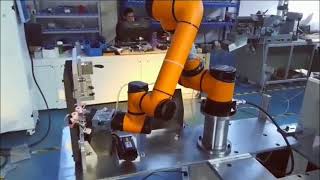
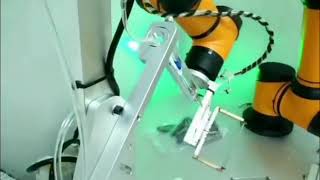
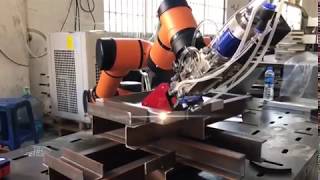
Image/s credit: AUBO Robotics.

AUBO i-Series Cobots

company logo for AUBO Robotics AUBO Robotics

Country: China

Year: 2015

Summary

AUBO i-series is a family of 6-axis collaborative robots covering 3 kg to 20 kg payloads, designed for flexible industrial automation, easy programming, & human-robot collaboration

Status: Commercially available

Operation: Semi-autonomous, Collaborative, Tethered

Robot Type / Domain: Multi/General-Purpose, Industrial

Tasks: Machine tending, pick-and-place, assembly, screwdriving, welding, packaging, inspection, polishing, handling

Technical Specifications (series range)

Reach: 625 to 1650 mm

Reach: 24.606 to 64.961 in

Payload: 3 to 20 kg

Payload: 6.614 to 44.092 lbs

Pose Repeatability: ± 0.02 to ± 0.1 mm

Pose Repeatability: ± 0.001 to ± 0.004 in

Weight: 16 to 63 kg

Weight: 35.274 to 138.891 lbs

Battery Operated? No, Tethered

Arm Type: Articulated, Collaborative

Number of Axes: 6 DoF

IP Rating: IP54

Mounting: Floor, Ceiling, Wall, Any desired angle

Footprint: N/A

Operating Temperature: 0 ℃ to 50 ℃

Operating Temperature: 32.000 ℉ to 122.000 ℉

Footprint: Ø140 mm to Ø260 mm footprint diameter

Operating Humidity: 90% RH, non-condensing

Tool Speed: Up to ≤2.5 m/s to ≤4.0 m/s depending on model

Software: SDK support listed for C/C++/C#/Lua/Python/JavaScript on Windows and Linux, with ROS/ROS2 support

Power Consumption: 150 W to 1000 W depending on model | Peak Power: 1000 W to 3000 W depending on model

Data Transmission / Communication: Ethernet, ModBus-RTU/TCP, Profinet, EtherNet/IP optional

No more specs to show.

Top 5+ Qualities (by addoobot)

What we find to be the top qualities of the AUBO i-series Cobots:

  • Wide Payload Coverage: The i-series spans from compact 3 kg models up to a 20 kg payload option, making it useful across light, medium, and heavier collaborative automation tasks.
  • Collaborative Safety Features: AUBO highlights safety certifications, collision detection, and sensor safety features, but real deployment should still include a proper risk assessment.
  • Open Integration: The platform supports SDK/API access and multiple communication methods, helping it connect with end-effectors, vision systems, and mobile equipment.
  • Simple Programming: Operators can use drag teaching, coordinate positioning, path planning, and offline programming, which makes the robot easier to deploy and adjust.
  • Compact and Modular Design: AUBO describes the i-series as lightweight and modular, which helps with integration, servicing, and flexible automation layouts.
  • Good Precision for Industrial Tasks: The smaller and mid-range models offer repeatability down to ±0.02 mm, which is useful for repetitive handling, assembly, inspection, and production tasks.
  • Cleanroom-Friendly: The i-series is listed with ISO 14644-1 Cleanroom Class 5, which can make it suitable for cleaner production environments where appropriate integration is used.

More Videos

Play video background image - video 2
Example Application: Sand and Polish by AUBO Cobots
Play video background image - video 2
Path Profiles for AUBO Robotics' Cobots
Play video background image - video 2
Example Application: Laser Welding

Learn More

What Makes the AUBO i-series Useful

The AUBO i-series is useful because it is not just one cobot arm; it is a full product family. The range starts with the compact AUBO-i3 and goes up to the larger AUBO-i20. This gives users several options depending on whether they need a small arm for lightweight assembly or a stronger arm for heavier handling and longer reach. The current official AUBO page lists seven models: i3, i5, i7, i10, i12, i16, and i20.

Smaller models are lighter and easier to place in compact workspaces, while larger models provide more payload and reach. The i-series also supports common collaborative robot programming methods, including drag teaching and offline programming, which helps make the robots easier to apply in practical production environments.

Applications

AUBO positions the i-series for a broad range of industrial automation tasks. Suitable applications include machine tending, assembly, pick-and-place, packaging, welding, palletizing, inspection, screwdriving, and general material handling. AUBO’s own website lists industries such as 3C, automotive, hardware and household appliances, sanitary appliances, medical health, research and education, catering, new retail, daily chemicals, and logistics.

For small and light tasks, the i3 and i5 are more natural fits. They are easier to place into compact workcells and are better suited to small part handling, light assembly, inspection, and education or research setups. The i10 gives more reach and payload, making it more useful for machine tending or wider workspaces. The i16 is interesting because it offers a heavier payload than the i10 but with a shorter reach. The i20 is the largest option in the current AUBO i-series line-up and is better suited to heavier handling or longer-reach applications.

Model Comparison

Model: AUBO-i3
Payload: 3 kg | Reach: 625 mm | Robot Weight: 16 kg | Repeatability: ±0.02 mm
Best suited for: Small-part handling, compact assembly, inspection, light pick-and-place, and education/research setups.

Model: AUBO-i5
Payload: 5 kg | Reach: 886.5 mm | Robot Weight: 24 kg | Repeatability: ±0.02 mm
Best suited for: Light-to-medium handling, machine tending, screwdriving, assembly, packaging, and general factory automation.

Model: AUBO-i7
Payload: 7 kg | Reach: 786.5 mm | Robot Weight: 24 kg | Repeatability: ±0.02 mm
Best suited for: Medium-payload tasks where compact reach is still useful, including handling, assembly, and production support.

Model: AUBO-i10
Payload: 10 kg | Reach: 1350 mm | Robot Weight: 38.5 kg | Repeatability: ±0.03 mm
Best suited for: Machine tending, longer-reach pick-and-place, packaging, material handling, and medium-duty automation.

Model: AUBO-i12
Payload: 12 kg | Reach: 1250 mm | Robot Weight: 40 kg | Repeatability: ±0.03 mm
Best suited for: Medium-heavy handling, machine tending, and production tasks needing more payload than the i10 but slightly less reach.

Model: AUBO-i16
Payload: 16 kg | Reach: 967.5 mm | Robot Weight: 38 kg | Repeatability: ±0.03 mm
Best suited for: Higher-payload tasks in a more compact working radius, including handling heavier parts, machine loading, and industrial support tasks.

Model: AUBO-i20
Payload: 20 kg | Reach: 1650 mm | Robot Weight: 63 kg | Repeatability: ±0.1 mm
Best suited for: Heavier handling, longer-reach machine tending, larger workpieces, and applications where payload and reach are more important than ultra-compact size.

DO NOT COPY

Do Not Copy

Brief History

AUBO’s development history starts before the formal company launch. According to AUBO’s official history, R&D on its collaborative robot began in 2010, a concept machine appeared in 2011, and a first-generation AUBO collaborative robot appeared in 2013. The professional team was formally established in 2014, and AUBO (Beijing) Robotics Technology Co., Ltd. was established in 2015. That same year, the AUBO-i5 collaborative robot was launched globally.

The i-series then expanded. AUBO lists the global launch of i3, i7, and i10 in 2017, followed by the global launch of the AUBO i16 and iV-series in 2019. Today, AUBO lists the i-series with i3, i5, i10, i16, and i20 models, covering payloads from 3 kg to 20 kg.

Please visit the official website for more accurate, up-to-date, and complete information on this post. Visit Website   External Link Icon Specifications   External Link Icon

Disclaimer: For informational purposes only. The provided data and/or content are intended as references and may contain errors. We appreciate your help in maintaining accuracy; if you spot any errors, please notify us. For the most reliable and up-to-date information, kindly refer to the official website. By using addoobot and its contents and services, you agree to our Terms and Conditions, Privacy Policy, and Cookie Policy.

Thumbs Down Icon Thumbs Up Icon
0 1 2 3 4 5 6 7 8 9 10

Select appealing qualities


 0 Comments

Sign in to comment, reply, and more

No Comments Yet

Be the first to share your thoughts!