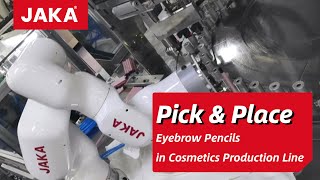
Image/s credit: JAKA Robotics.

JAKA Mini Series Cobots

Creator: JAKA Robotics

Country: China

Year: 2021

Summary

The JAKA Mini Series focuses on compact, lightweight, and easy-to-deploy cobots for small payload tasks across industry, education, service, and research environments.

Status: Commercially available

Operation: Semi-autonomous, Collaborative, Tethered

Robot Type / Domain: Multi/General-Purpose, Research, Industrial, Service, Educational

Tasks: Handling, sorting, inspection, flexible assembly, flexible gripping, loading and unloading, gluing, light polishing/grinding

Technical Specifications (series range)

Reach: 580 to 580 mm

Reach: 22.835 to 22.835 in

Payload: 1 to 2 kg

Payload: 2.205 to 4.409 lbs

Pose Repeatability: ± 0.05 to ± 0.1 mm

Pose Repeatability: ± 0.002 to ± 0.004 in

Weight: 9.4 to 9.9 kg

Weight: 20.723 to 21.826 lbs

Battery Operated? No, Tethered

Arm Type: Articulated, Collaborative

Number of Axes: 6 DoF

IP Rating: IP40

Mounting: Floor, Ceiling, Wall, Any desired angle

Footprint: 124 mm × 124 mm (length × width)

Footprint: 4.882 in × 4.882 in (length × width)

Operating Temperature: 0 ℃ to 50 ℃

Operating Temperature: 32.000 ℉ to 122.000 ℉

Cable Length: 6 m

Software: Programming: PC, tablet, smartphone, or other graphical device | Graphical programming, drag-and-teach / drag-and-drop style programming; Mini 2 also lists SRCI and offline programming

Controller & Computing: Cabinet: MiniCab-style compact cabinet; listed cabinet size 180 × 128 × 47 mm; communication includes TCP/IP, Modbus TCP, Modbus RTU, Profinet, and Ethernet/IP

Material: Aluminum / aluminum alloy and PC

Data Transmission / Communication: Tool I/O: 2 digital inputs, 2 digital outputs, 1–2 analog inputs depending on model listing | Tool I/O Power: 24 V DC | Tool I/O Size: M8

No more specs to show.

Top 5+ Qualities (by addoobot)

What we find to be the top qualities of the JAKA Mini Series Cobots:

  • Compact and Lightweight: Both Mini models weigh under 10 kg, making them easier to move, install, and redeploy than larger cobots.
  • Good for Small Payload Automation: With 1 kg and 2 kg payload options, the series is best suited to light handling, inspection, sorting, small assembly, and service-style automation.
  • Simple to Program: Graphical programming and mobile/PC/tablet-based interfaces make the robots more accessible for teams without deep robotics programming experience.
  • Flexible Installation: Any-angle mounting makes the Mini Series useful for benches, compact cells, educational setups, and space-constrained workstations.
  • Cost-Effective Entry Point: JAKA positions the Mini Series as a more affordable way to start with collaborative automation, especially for smaller businesses, education, retail, hospitality, and light industrial tasks.
  • Mini 2 Upgrade Option: Mini 2 increases payload to 2 kg and is described by JAKA as offering faster cycle times while keeping the same compact style and footprint.
  • Good Ecosystem Fit: The Mini Series still sits inside the broader JAKA cobot ecosystem, so it can connect with JAKA programming tools, control hardware, and compatible automation workflows.

More Videos

Play video background image - video 2
JAKA MiniCobo Solving a Rubik's Cube
Play video background image - video 2
Example Application: Coffee Making with Mini
Play video background image - video 2
Example Application: Pencils Pick & Place

Learn More

What the JAKA Mini Series Is For

The JAKA Mini Series is designed for situations where a full-size cobot may be too large, too heavy, or more capable than needed. It is especially relevant for light-duty automation tasks such as small part handling, inspection, sorting, flexible gripping, simple loading and unloading, light assembly, gluing, service and hospitality, and education or research demonstrations. This makes the Mini Series a practical fit for small workstations, lab benches, demonstration cells, training environments, retail-style automation, and light industrial production. It is not designed to compete with heavy-payload cobots. Its value is in being small, approachable, and easier to deploy where space, budget, or task size is limited.

Benefits

The biggest benefit of the JAKA Mini Series is that it lowers the barrier to using collaborative robots. These robots are small enough for compact spaces, light enough to relocate, and simple enough to program using graphical interfaces and mobile devices. For small businesses, education, research labs, service environments, and light manufacturing, that matters because not every automation task needs a large industrial cobot.

JAKA Mini Series Model Comparison

Model: JAKA MiniCobo
Payload: 1 kg | Reach: 580 mm | Robot Weight: 9.4 kg | Accuracy: ±0.1 mm | Axes: 6 | IP Rating: IP40 robot arm / IP20 control cabinet
Best suited for: Very light handling, education, retail-style automation, laboratory tasks, simple inspection, flexible gripping, and compact first-step automation.

Model: JAKA Mini 2
Payload: 2 kg | Reach: 580 mm | Robot Weight: 9.9 kg | Accuracy: ±0.05 mm | Axes: 6 | IP Rating: IP40 robot arm / IP20 control cabinet
Best suited for: Light handling, sorting, inspection, 3D vision tasks, high-speed compact automation, and space-constrained workstations where the 1 kg MiniCobo may be too limited.

How It Differs from Other JAKA Cobot Series

The Mini Series is JAKA’s lightweight compact cobot range. That is the main difference. Compared with the broader JAKA lineup, it is focused on portability, compact installation, low payload work, and accessible automation rather than high payload, harsh-environment protection, or advanced sensing. So the Mini Series is best understood as JAKA’s compact cobot option: smaller, lighter, and easier to place in tight workspaces, but with much lower payload capacity than JAKA’s larger collaborative robot arms.

Practical Takeaway

Choose MiniCobo if the application is very light, highly space-constrained, education-focused, or service-oriented. Choose Mini 2 if the user wants the same compact Mini-style robot but with higher payload, better stated accuracy, and broader practical use for small industrial automation. Neither model should be positioned as a heavy-duty cobot. The right framing is: small, lightweight, affordable, flexible, and easy to start with.

DO NOT COPY

Do Not Copy

Please visit the official website for more accurate, up-to-date, and complete information on this post. Visit Website   External Link Icon

Disclaimer: For informational purposes only. The provided data and/or content are intended as references and may contain errors. We appreciate your help in maintaining accuracy; if you spot any errors, please notify us. For the most reliable and up-to-date information, kindly refer to the official website. By using addoobot and its contents and services, you agree to our Terms and Conditions, Privacy Policy, and Cookie Policy.

Thumbs Down Icon Thumbs Up Icon
0 1 2 3 4 5 6 7 8 9 10

Select appealing qualities


 0 Comments

Sign in to comment, reply, and more

No Comments Yet

Be the first to share your thoughts!