What Makes the DOBOT MG400 Special
The DOBOT MG400 is different from most collaborative robots because it is built around the idea of desktop automation. Instead of being a large 6-axis cobot mounted to a production floor, the MG400 is a compact 4-axis robot that can sit on a bench, workstation, lab table, or small production cell. This makes it especially useful where space is limited or where the task involves small, lightweight parts.
Its 440 mm working radius and 750 g maximum payload are not designed for heavy industrial handling, but that is not really the point of this robot. The MG400 is more about making automation accessible for small-batch production, electronics work, testing, inspection, education, and research. It gives users a practical way to automate repetitive light-duty tasks without needing a large robot cell.
It is also relatively beginner-friendly. Drag-to-teach and graphical programming make it easier for non-expert users to start, while Lua scripting gives more technical users extra flexibility. In short, the MG400 is best understood as a compact, precise, desktop cobot for lightweight automation rather than a replacement for larger industrial cobot arms.
Applications and Benefits
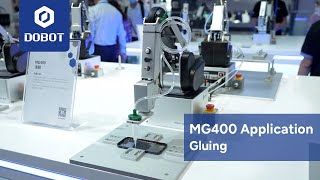
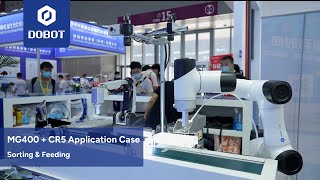
The MG400 is well suited to lightweight, repetitive tasks where the parts are small and the workspace is compact. Common application areas include pick-and-place, loading and unloading, assembly, gluing or dispensing, inspection, testing, sorting, and small product handling. It can also be useful in education and research, where users need a real robot arm for demonstrations, prototyping, automation experiments, or robotics training.
In light manufacturing, the MG400 can help with tasks such as moving small components between fixtures, placing parts for testing, assisting with small assembly steps, or handling samples in controlled workflows. In labs, it can support repeatable motion tasks where consistency matters more than payload strength. In education, it gives students and researchers a compact platform for learning robot programming, automation logic, vision-based tasks, and human-robot collaboration concepts.
The main thing to remember is that the MG400 is not designed for large products, heavy tools, palletising, welding, or long-reach industrial work. It is strongest when the job is small, repetitive, precise, and located within a desktop-sized workspace.
How MG400 Differs from Other DOBOT Cobot Series
The MG400 is quite different from DOBOT’s larger cobot families. The main difference is size and purpose. MG400 is a desktop 4-axis robot with a very small payload, while series such as DOBOT CRA, CRS, CRAF, CRA-IP68, Nova, and CR 30H are larger 6-axis cobots aimed at broader industrial or commercial automation tasks.
The Nova Series is also compact, but it is a 6-axis cobot family with higher payloads and longer reach, aimed at commercial, retail, hospitality, healthcare, and light industrial applications. The CRS Series focuses more on SafeSkin-enabled human-machine collaboration with larger payload and reach options. The CRA Series is DOBOT’s newer general industrial cobot family, covering much heavier payloads and a wider range of factory tasks. CRAF adds force-control capability for applications such as polishing, grinding, and precise contact tasks. CRA-IP68 is for harsh or wet environments. CR 30H is the heavy-payload option for demanding handling and palletising.
So the simple way to describe it is this: MG400 is DOBOT’s compact desktop automation cobot, while the larger DOBOT cobot series are better suited to full-size industrial, commercial, force-control, harsh-environment, or heavy-payload applications.
 Research
  Industrial
  Consumer
  Social
  Service
  Assistive
  Medical & Healthcare
  Emergency Response
  Building & Construction
  Other Infrastructure
  Transport
  Arts & Entertainment
  Agriculture & Forestry
  Law & Order / Security
  Other
Other 

 DOBOT
DOBOT 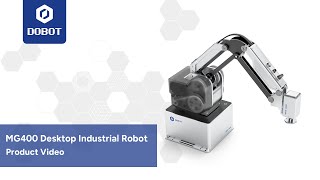


 Multi/General-Purpose Robots
  View All
  Linkedin
 in Sydney, Australia.
Share