Applications: From Assembly to Food Handling
DENSO COBOTTA PRO cobots are designed to automate a variety of industrial tasks, particularly those requiring a combination of speed, precision, and collaboration with human workers.
Assembly is one of their main applications. Their precise movements and force-control capabilities can help with tasks such as positioning components, inserting parts, and supporting multi-step assembly processes. DENSO has also demonstrated COBOTTA PRO working alongside people in collaborative assembly operations.
The series can also handle pick-and-place, component handling, and inspection tasks. When combined with compatible 3D vision systems, COBOTTA PRO can identify and pick objects, including in applications where objects vary in position or appearance.
Beyond traditional manufacturing, DENSO has demonstrated COBOTTA PRO in food-related automation. Examples include weighing ingredients, preparing food items, and packaging prepared meals.
These applications show how the series can support both repetitive tasks and more complex operations that involve additional sensors, software, or human interaction.
High Speed Without Forgetting Safety
One of the standout features of COBOTTA PRO is its focus on combining high-speed performance with collaborative safety. The COBOTTA PRO 900 reaches a maximum TCP speed of 2,100 mm/s, while the larger 1300 model reaches 2,500 mm/s during non-collaborative operation.
To support safe collaboration with human workers, DENSO has equipped the robots with torque sensors at every joint, along with safety functions that monitor torque, speed, and operating areas.
An optional touch-sensing soft cover adds another layer of protection. It combines soft cushioning with sensitive contact sensors that can detect collisions and trigger the robot to stop. DENSO specifies that the cover also allows a higher maximum speed during collaborative operation.
Another useful feature is the configurable scene function, which lets users adjust safety parameters for different tasks or operating conditions.
Together, these features help COBOTTA PRO balance productivity with human-robot collaboration. However, safe operation still depends on appropriate installation, risk assessment, and application-specific safety measures.
Easy Programming and Advanced Integration
Despite their industrial capabilities, COBOTTA PRO cobots are designed to make programming and operation more accessible.
With direct teaching, users can physically guide the robotic arm to demonstrate positions and movements. For tasks requiring more precise positioning, optional fine-teaching functions allow adjustments in increments of around 0.1 mm.
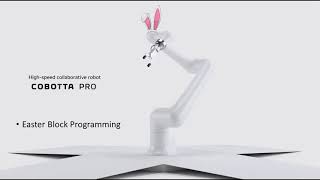
DENSO also offers a Blockly-based programming system, allowing users to create robot operations by connecting visual blocks rather than writing conventional code. This can make programming easier for beginners while supporting more involved automation sequences.
For more advanced applications, the series uses DENSO's CRC9 controller, which supports coordinated control of the robot and connected equipment. The controller also provides an open development environment for users and system integrators.
COBOTTA PRO can be combined with compatible vision systems, force-control functions, and other automation technologies for tasks requiring object recognition and coordinated movements.
This combination of intuitive teaching and advanced integration makes the series useful for both straightforward automation and more complex manufacturing processes.
COBOTTA PRO 900 vs COBOTTA PRO 1300
Model: COBOTTA PRO 900
Payload: 6 kg | Nominal Arm Length: 900 mm | Max. Arm Reach: 1,066 mm | Robot Weight: Approx. 29 kg | Repeatability: ±0.03 mm | Max. TCP Speed: 2,100 mm/s
Best suited for: Light-to-medium component handling, precise assembly, inspection, and automation setups requiring a smaller robot.
Model: COBOTTA PRO 1300
Payload: 12 kg | Nominal Arm Length: 1,300 mm | Max. Arm Reach: 1,463 mm | Robot Weight: Approx. 41 kg | Repeatability: ±0.04 mm | Max. TCP Speed: 2,500 mm/s
Best suited for: Heavier component handling, assembly processes requiring greater reach, and applications needing higher payload capacity or a larger working area.
Main Difference: The COBOTTA PRO 900 offers a smaller and lighter design with slightly better position repeatability, while the COBOTTA PRO 1300 provides twice the payload capacity, greater reach, and a higher maximum TCP speed. Both models share the same core collaborative safety features, programming options, and controller platform.
DENSO COBOTTA vs. COBOTTA PRO Series
While both are collaborative robots from DENSO, they serve different purposes. The original COBOTTA is a compact, lightweight cobot weighing just 4 kg, with a 0.5 kg payload, making it ideal for education, research, and light-duty automation.
In contrast, the COBOTTA PRO series is built for more demanding industrial tasks, offering higher payloads (6–12 kg), greater reach, faster speeds, and advanced safety features. In short, COBOTTA focuses on portability and simplicity, while COBOTTA PRO prioritizes industrial performance and productivity.
 Research
  Industrial
  Consumer
  Social
  Service
  Assistive
  Medical & Healthcare
  Emergency Response
  Building & Construction
  Other Infrastructure
  Transport
  Arts & Entertainment
  Agriculture & Forestry
  Law & Order / Security
  Other
Other 
 DENSO Robotics


 Multi/General-Purpose Robots
  View All
  Linkedin
 in Sydney, Australia.
Share