Applications
DENSO COBOTTA is designed for handling small objects and automating simple, repetitive tasks. Its compact size and lightweight design make it especially useful where space is limited or a traditional industrial robot would be difficult to install.
In manufacturing, COBOTTA can perform tasks such as pick-and-place, small-part assembly, inspection, sorting, and dispensing. DENSO has demonstrated it in applications ranging from assembling miniature cars and packaging tea bags to circuit-board inspection and automated coating processes.
COBOTTA is also useful in research laboratories, where it can help automate repetitive handling and analysis tasks. Its relatively small size allows it to fit into laboratory environments, while its programmable movements can support repeatable experiments.
Education is another important application. COBOTTA is used in robotics teaching and research, allowing students to learn robot programming, automation, and human-robot collaboration using a real six-axis robotic arm.
What Makes COBOTTA Special?
One of COBOTTA's standout features is how much functionality DENSO has packed into such a small robot. Weighing approximately 4 kg, including its controller, COBOTTA can be moved between workstations much more easily than larger industrial robotic arms. Its controller is built directly into the robot, reducing external wiring and simplifying installation.
Safety is another important part of its design. COBOTTA has smooth, rounded surfaces without sharp edges or pinch points, while sensors monitor speed and torque across its six axes. These features support operation near people and can allow applications without traditional safety fencing, depending on the risk assessment.
COBOTTA also offers a position repeatability of ±0.05 mm, making it suitable for repetitive tasks that require consistent positioning. Combined with its compact dimensions, portability, and easy teaching functions, it provides a practical option for light automation, education, and research.
Easy Programming & Flexible Development
COBOTTA is designed to be approachable for beginners while offering additional flexibility for more experienced developers. One of its most useful features is direct teaching, which allows users to physically guide the robot through movements rather than programming every position manually.
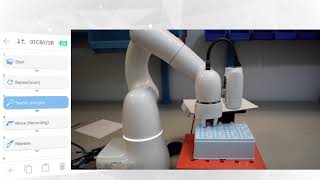
DENSO's COBOTTA World application provides an intuitive way to build task sequences using predefined actions such as moving and gripping. For users who need more advanced programming and control, DENSO also offers tools such as Remote TP.
The robot can be equipped with optional accessories, including an electric gripper, vacuum gripper, and wrist-mounted autofocus camera. These allow it to handle different objects and perform vision-guided tasks.
For developers and researchers, DENSO also provides an OSS version with a published control API, supporting custom software development. Together with Ethernet connectivity and optional industrial networking interfaces, this gives COBOTTA room to support more specialized automation projects.
DENSO COBOTTA vs COBOTTA PRO: What's the Difference?
While both COBOTTA and COBOTTA PRO are collaborative robots developed by DENSO, they are designed for different needs. The original COBOTTA focuses on portability, simplicity, and light-duty automation. Weighing just 4 kg and handling payloads of up to 0.5 kg under normal conditions, it's a great fit for small-scale tasks, education, and research. Its compact design, built-in controller, and easy programming make it particularly convenient for users who need a flexible, easy-to-use cobot.
COBOTTA PRO, on the other hand, is designed for more demanding industrial applications where speed, reach, and payload capacity matter. Available in two models, the PRO 900 and PRO 1300, these cobots handle payloads of 6 kg and 12 kg, respectively, and offer significantly greater reach and higher operating speeds. They're particularly suited for industrial assembly, inspection, and other automated production tasks. In short, COBOTTA is a great choice for portability and lighter tasks, while COBOTTA PRO is better suited for heavier, faster, and more demanding automation.
 Research
  Industrial
  Consumer
  Social
  Service
  Assistive
  Medical & Healthcare
  Emergency Response
  Building & Construction
  Other Infrastructure
  Transport
  Arts & Entertainment
  Agriculture & Forestry
  Law & Order / Security
  Other
Other 
 DENSO Robotics


 Multi/General-Purpose Robots
  View All
  Linkedin
 in Sydney, Australia.
Share