Applications
The Universal Robots g-Series is designed for a wide range of industrial automation tasks, from repetitive material handling to more advanced manufacturing processes. With three models offering different payloads and reaches, the series can be used for applications such as pick-and-place, machine tending, assembly, packaging, palletizing, and inspection.
The UR10g-1750 stands out for its long 1,750 mm reach, making it particularly useful for tasks that require access across larger workspaces. The UR17g-1300 offers a balance between reach and payload capacity, while the UR18g-950 focuses on handling heavier loads over shorter distances.
The series also supports the integration of cameras, sensors, and other end-of-arm tools, making it suitable for more advanced automation applications. These capabilities give manufacturers flexibility to develop solutions based on their production requirements.
What Makes These Cobots Special?
One of the biggest improvements introduced with the g-Series is its enhanced tool flange. Unlike earlier Universal Robots arms, the new design brings high-speed Ethernet, higher-power electrical connections, and safety inputs directly to the end of the robot arm.
This makes it easier to connect equipment such as cameras, sensors, and powered grippers without having to run as many external cables along the robot. It can simplify installation, reduce wiring complexity, and support applications that use more advanced sensing and control.
The robots also feature integrated force/torque sensing, high-speed motion capabilities, and IP65 protection. Another useful addition is the optional SP7 Smart Panel, which provides controls directly at the end of the arm for hand-guided teaching and other configurable functions. Together, these features make the g-Series a more connected and integration-friendly generation of Universal Robots cobots.
Gen 7 Platform and Intelligent Automation
The g-Series is part of Universal Robots' Gen 7 platform, which brings together the robot arms, CB7 Core controller, TP7 Core teach pendant, and PolyScope X software into an integrated automation system.
This platform is designed to simplify robot programming, improve connectivity, and support more advanced industrial applications. Its controller offers multiple Ethernet connections for connecting equipment such as PLCs, computers, and vision systems, while PolyScope X provides an accessible programming interface for users.
Universal Robots also designed Gen 7 with AI-enabled automation in mind. By providing better connectivity for cameras, sensors, and external computing systems, the platform makes it easier to integrate technologies such as machine vision and AI-based control.
However, being AI-ready does not mean that these cobots are inherently autonomous AI robots. Their advanced capabilities depend on the software, sensors, and other components used in a particular application.
g-Series Model Comparison
UR10g-1750
Payload: 8 kg standard, 10 kg expanded | Reach: 1,750 mm | Robot Weight: 44.7 kg | Repeatability: ±0.08 mm | Max TCP Speed: 5 m/s
Best suited for: Long-reach pick-and-place, material handling, and applications that benefit from an extended working area.
UR17g-1300
Payload: 15 kg standard, 17.5 kg expanded | Reach: 1,300 mm | Robot Weight: 40.7 kg | Repeatability: ±0.05 mm | Max TCP Speed: 5 m/s
Best suited for: Medium-to-heavy material handling, machine tending, and assembly tasks requiring a balance of reach and payload.
UR18g-950
Payload: 18 kg | Reach: 950 mm | Robot Weight: 39.2 kg | Repeatability: ±0.05 mm | Max TCP Speed: 4 m/s
Best suited for: Higher-payload, shorter-reach pick-and-place, fast assembly, and material handling tasks.
g-Series vs Other Universal Robots Cobot Series
Universal Robots currently offers three main cobot families: the e-Series, UR Series, and g-Series. The e-Series, introduced in 2018, focuses on lighter payloads, shorter reaches, and compact automation applications. The UR Series, introduced in 2022, was designed for heavier payloads, longer reaches, and demanding industrial tasks. The g-Series, launched in 2026, builds on the UR Series architecture while adding enhanced connectivity directly at the tool flange, making it easier to integrate cameras, sensors, and more advanced end-effectors.
The g-Series also succeeds three earlier UR Series models: the UR8 Long, UR15, and UR18, which correspond to the new UR10g-1750, UR17g-1300, and UR18g-950 respectively. The UR20 and UR30 remain active for applications requiring higher payloads, reaching up to 35 kg in expanded configurations. Overall, the g-Series focuses on connectivity and integration improvements rather than simply increasing payload capacity. All three families remain part of Universal Robots' industrial automation offering, with the most suitable choice depending on the application.
 Research
  Industrial
  Consumer
  Social
  Service
  Assistive
  Medical & Healthcare
  Emergency Response
  Building & Construction
  Other Infrastructure
  Transport
  Arts & Entertainment
  Agriculture & Forestry
  Law & Order / Security
  Other
Other 
 Universal Robots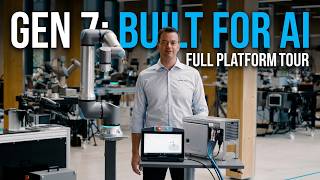


 Multi/General-Purpose Robots
  View All
  Linkedin
 in Sydney, Australia.
Share