Applications
Sawyer was developed for manufacturing environments where flexibility, precision, and the ability to work around existing equipment were important. With its 4 kg payload, 1,260 mm reach, and seven-axis robotic arm, it was particularly suited to handling smaller components and performing repetitive industrial tasks.
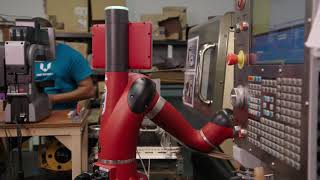
Its intended applications included machine tending, circuit board testing, material handling, packaging, kitting, and line loading. Sawyer could also be equipped with suitable end-effectors for pick-and-place operations and other handling tasks.
One of its distinctive capabilities was compliant motion, which allowed the arm to respond to physical contact and variations in component positioning. This made it useful for tasks involving fixtures and machinery where objects might not always be positioned exactly the same way.
With its integrated cameras and force sensors, Sawyer offered manufacturers a way to explore flexible automation without relying entirely on traditional industrial robot programming.
What Made Sawyer Special?
Sawyer stood out because it approached industrial robotics differently from many traditional robotic arms. Rather than focusing solely on speed, payload, and precision, Rethink Robotics placed considerable emphasis on making robots easier for people to work with.
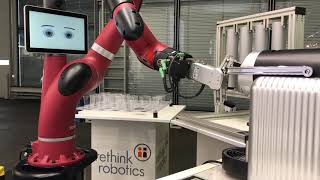
One of Sawyer's most recognizable features was its screen displaying animated eyes. Alongside its red robotic arm, this gave Sawyer a distinctive appearance that made it immediately recognizable.
But its innovations went beyond appearance. Sawyer used series elastic actuators and integrated force sensors to support compliant movements, while its Intera software allowed users to teach tasks by physically guiding the robotic arm.
This approach aimed to make robot programming more accessible to factory workers who did not necessarily have extensive robotics programming experience.
Sawyer was not the first collaborative robot, but it was an influential example of the shift toward more approachable, flexible, and human-centered industrial automation.
Research and Education
Although Sawyer was originally developed for industrial automation, it also became a platform for robotics research and education.
In 2016, Rethink Robotics introduced Sawyer to the global research and education markets with an open-source software development kit built around the Robot Operating System (ROS). This gave researchers and students additional ways to develop and experiment with robotic applications.
Sawyer's seven-axis arm, embedded cameras, and force-sensing capabilities made it suitable for exploring topics such as robot manipulation, grasping, machine vision, and human-robot interaction.
The research software also supported more advanced programming than the standard train-by-demonstration interface. Later SDK developments included integration with the Gazebo simulator, allowing researchers to test robotic applications in a simulated environment.
Although Sawyer is no longer a current commercial product, its research software and documented capabilities remain part of its contribution to robotics development and education.
Benefits and Limitations
Sawyer offered an alternative to traditional industrial automation by combining a lightweight arm with flexible programming and sensing capabilities. Its 4 kg payload and 1,260 mm reach made it suitable for handling relatively light objects across a useful working area.
Its train-by-demonstration approach allowed operators to configure tasks without always needing specialist robot programming knowledge. Combined with built-in vision and force sensing, this made Sawyer attractive for production processes involving changing tasks or part positions.
However, Sawyer had limitations. Its 4 kg payload restricted heavier handling applications, and its collaborative design did not eliminate the need for application-specific safety assessments or additional safeguarding where necessary.
Sawyer is also no longer a current commercial product. Anyone considering an existing unit would need to assess its mechanical condition, software compatibility, maintenance requirements, and availability of replacement parts and technical support.
 Research
  Industrial
  Consumer
  Social
  Service
  Assistive
  Medical & Healthcare
  Emergency Response
  Building & Construction
  Other Infrastructure
  Transport
  Arts & Entertainment
  Agriculture & Forestry
  Law & Order / Security
  Other
Other 
 Rethink Robotics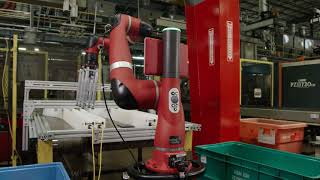


 Research Robots
  View All
  Linkedin
 in Sydney, Australia.
Share