A Robot That Can See, Hear and Respond
What makes MAiRA different from many conventional collaborative robots is its emphasis on cognitive capabilities. Instead of relying only on programmed movements, MAiRA brings together artificial intelligence and multiple sensing technologies to help it understand and respond to its surroundings.
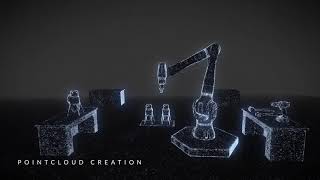
Its integrated 3D vision system supports object detection and tracking, while its audio system enables voice-based interaction. MAiRA also supports force-related feedback through an optional six-axis force-torque sensor. These capabilities offer different ways of interacting with the robot, whether through a visual interface, voice commands or physical guidance.
NEURA also promotes its Touchless Safe Human Detection technology, which can detect people within a surrounding area and use different safety responses based on proximity. This allows MAiRA to be considered for workspaces where human interaction is important, subject to the appropriate safety configuration and risk assessment.
Together, these technologies make MAiRA particularly interesting for applications requiring perception, flexibility and human-robot collaboration rather than simply repeating a fixed movement sequence.
Applications and Industrial Automation
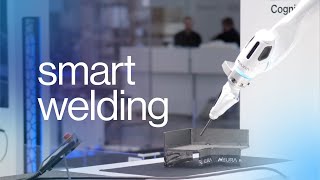
MAiRA is designed for automation tasks where sensing and adaptability can provide practical advantages. NEURA has demonstrated MAiRA in industrial bin-picking and precision applications, while its wider industrial automation offerings cover activities such as machine tending, palletizing and quality inspection.
For example, vision-assisted object handling can be useful when objects are not always presented in identical positions or orientations. This can make MAiRA relevant to applications involving variable products or layouts, provided the necessary software, end effector and integration are available.
MAiRA's three configurations also offer different options depending on the application. The S model prioritises payload capacity, the M model offers a balance between payload and reach, and the L model provides the longest working reach.
Its seven-axis design provides additional movement flexibility, while mounting in any orientation allows the robot to be integrated into different types of production cells. Developers can also use NEURA's Python API to create more specialised integrations and applications.
What Makes MAiRA Special?
MAiRA represents NEURA Robotics' approach to combining collaborative robots with artificial intelligence and advanced perception. While traditional industrial automation often depends on predictable tasks and carefully structured workspaces, MAiRA is designed to support applications where robots benefit from recognising objects, receiving instructions and responding to changes around them.
Another distinctive feature is its seven-axis configuration. The additional joint provides greater kinematic redundancy than a typical six-axis arm, offering more flexibility in how the robot positions itself to achieve a task. All three MAiRA models also share a compact Ø252 mm mounting base, despite their different reaches and payload capacities.
Perhaps its biggest distinguishing characteristic, however, is the combination of vision, audio interaction, optional force sensing and touchless human detection within the same product family.
These capabilities position MAiRA as more than a conventional programmable robot arm. It is designed as a cognitive robotic platform for industrial automation and human-robot interaction, although the availability and performance of individual capabilities depend on the selected configuration and application.
MAiRA Series Model Comparison
MAiRA S
Payload: 15–18 kg | Reach: 1,100 mm | Robot Weight: 51 kg | Axes: 7 | IP Rating: IP65
Relative advantage: Highest payload capacity in the MAiRA range, making it the logical choice when heavier loads matter more than maximum reach.
MAiRA M
Payload: 12–14 kg | Reach: 1,400 mm | Robot Weight: 53 kg | Axes: 7 | IP Rating: IP65
Relative advantage: Balances payload capacity and working reach, sitting between the S and L models.
MAiRA L
Payload: 9–11 kg | Reach: 1,600 mm | Robot Weight: 56 kg | Axes: 7 | IP Rating: IP65
Relative advantage: Longest reach in the MAiRA range, suitable for considering applications that require a larger working area with lighter loads.
NEURA MAiRA vs LARA Series
NEURA Robotics offers both the MAiRA and LARA cobot families, but they are designed with different priorities. LARA focuses on practical industrial automation, offering nine six-axis models with payloads from 3 to 30 kg and reaches up to 1,800 mm. It is primarily suited to applications requiring straightforward programming, precision and reliable repetitive operations. MAiRA, on the other hand, places much greater emphasis on cognitive robotics. It combines seven-axis movement with integrated vision, audio interaction, AI capabilities and advanced sensing technologies, making it particularly relevant to applications that benefit from greater environmental awareness and human-robot interaction.
The main difference is therefore not simply payload or reach. LARA is focused on flexible industrial automation, while MAiRA is designed for more perception-driven and interactive robotic applications. LARA offers a wider selection of payload capacities and higher maximum payload, whereas MAiRA provides an additional axis and a broader set of cognitive capabilities. Both can perform industrial tasks, but MAiRA's additional sensing and interaction capabilities may offer advantages in more variable or complex environments.
 Research
  Industrial
  Consumer
  Social
  Service
  Assistive
  Medical & Healthcare
  Emergency Response
  Building & Construction
  Other Infrastructure
  Transport
  Arts & Entertainment
  Agriculture & Forestry
  Law & Order / Security
  Other
Other 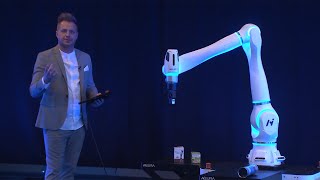


 Multi/General-Purpose Robots
  View All
  Linkedin
 in Sydney, Australia.
Share