Image/s credit: Elephant Robotics.

Elephant Robotics myCobot Pro Series Cobots

company logo for Elephant Robotics Elephant Robotics
Country: China

Year: 2021

Summary

A professional six-axis cobot series combining compact all-in-one designs, open programming tools, and payloads up to 2 kg for education, research, and light automation.

Status: Commercially available

Operation: Collaborative, Tethered

Robot Type / Domain: Multi/General-Purpose, Research, Industrial, Educational

Tasks: Pick-and-place, sorting, palletizing, loading & unloading, inspection, testing, writing & drawing, vision-guided handling, education & research.

Technical Specifications (series range)

Reach: 450 to 630 mm

Reach: 17.717 to 24.803 in

Payload: 1 to 2 kg

Payload: 2.205 to 4.409 lbs

Pose Repeatability: ± 0.1 mm

Pose Repeatability: ± 0.004 in

Weight: 5 to 10 kg

Weight: 11.023 to 22.046 lbs

Battery Operated? No, Tethered

Arm Type: Articulated, Collaborative

Number of Axes: 6 DoF

IP Rating: N/A

Mounting: Floor, Other

Footprint: N/A

Operating Temperature: 0 ℃ to 45 ℃

Operating Temperature: 32.000 ℉ to 113.000 ℉

Service Life: >10,000 hours

Joint Technology: Pro 450: integrated harmonic reducer, servo motor and joint brake modules; Pro 630: self-developed harmonic joint modules

Software: Python and C++; additional software/framework support depends on model

Controller & Computing: ROS, RViz, MoveIt and other tools supported depending on model

Power supply: Pro 450: 24 V, 9.2 A; Pro 630: DC 48 V

Data Transmission / Communication: Ethernet/network, wireless and industrial communication options; exact interfaces vary by model

No more specs to show.

Top 5+ Qualities (by addoobot)

What we find to be the top qualities of the Elephant Robotics myCobot Pro Series:

  • More Capable than the Desktop myCobots: The Pro family moves into 1–2 kg payloads and substantially larger working radii than the 250 g myCobot 280.
  • High Repeatability on Current Models: Both Pro 450 and Pro 630 are specified at ±0.1 mm repeatability under ISO 9283 measurement.
  • Harmonic-Drive Architecture: The Pro range uses harmonic transmission technology aimed at improving precision and performance compared with Elephant Robotics' smaller educational arms.
  • Professional Connectivity: Ethernet, Modbus, Socket communication, RS485 and other hardware interfaces make the current Pro models easier to integrate with peripherals and automation systems.
  • Compact All-in-One Design: Controllers and major electronics are integrated into the robot rather than requiring a large external control cabinet.
  • Strong Software Ecosystem: Python, ROS, graphical programming, simulation tools and open development resources support both beginners and experienced robotics developers.
  • Built for Education and Real Automation: Unlike a purely educational desktop arm, the Pro family is explicitly aimed at research, commercial deployment and light industrial automation as well as teaching.

More Videos

Play video background image - video 2
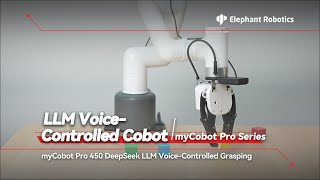
LLM-Powered myCobot Pro 450
Play video background image - video 2
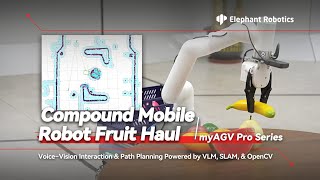
myCobot Pro 450 and myAGV Pro
Play video background image - video 2
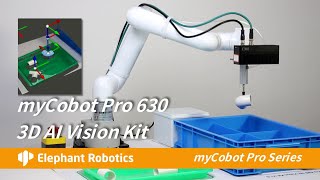
myCobot Pro 630 with 3D AI Vision

Learn More

From Desktop Robotics to Light Automation

The myCobot Pro range sits above Elephant Robotics' small desktop arms. The idea is still to keep the robot relatively compact and accessible, but to provide enough payload, reach, precision and connectivity for more serious applications.

The current Pro 450 provides a 450 mm working radius and 1 kg payload in a body weighing under 5 kg. The larger Pro 630 extends that to 630 mm and 2 kg while maintaining the same published ±0.1 mm repeatability. Both therefore occupy a middle ground between very small educational arms and much larger industrial cobots.

The software side reflects that positioning too. These robots still support accessible tools such as Python and visual programming, but they also bring in ROS, simulation resources and industrial communication interfaces such as Modbus and Ethernet-based protocols. This makes the Pro family useful not only for teaching robot programming, but also for prototype automation cells, machine-vision experiments, laboratory automation and integration research.

Applications and Expansion

Elephant Robotics demonstrates the current Pro robots across applications including 3D vision-based sorting, writing and painting, palletizing/sorting and mobile manipulation or inspection. The Pro 630 can also be combined with an AGV platform, while both current models support external cameras, grippers and other tooling.

The greater payload compared with the myCobot 280 also makes the Pro family more realistic for handling actual workpieces and larger end effectors. Pro 630, for example, supports the company's newer force-controlled and three-finger grippers as well as camera and suction-tool configurations.

This still does not make the Pro series equivalent to high-payload production cobots from companies such as Universal Robots or FANUC. With maximum payloads of 1–2 kg, these are best viewed as compact professional/light-automation cobots, particularly useful where space, education, research, prototyping or light-duty manipulation are important.

Comparing the myCobot Pro Models

Model: myCobot Pro 450
Year: 2025
Payload: 1 kg | Reach: 450 mm | Weight: <5 kg | Repeatability: ±0.1 mm | Lifespan: >10,000 h
Best suited for: Compact high-precision setups, education, research, desktop automation, vision sorting and light industrial applications.

Model: myCobot Pro 630
Year: 2024
Payload: ≤2 kg | Reach: 630 mm | Weight: <10 kg | Repeatability: ±0.1 mm | Lifespan: >10,000 h
Best suited for: Larger workspaces, heavier tooling or objects, commercial automation, visual sorting, palletizing experiments and mobile manipulation.

Earlier Model: myCobot Pro 600
Year: 2021
Payload: 2 kg | Reach: 600 mm | Weight: 8.8 kg | Repeatability: ±0.5 mm
Best suited for: Earlier-generation teaching, research and light-commercial applications; it was the predecessor from which the Pro 630 was developed.

myCobot Pro Series vs myCobot 280

The myCobot Pro Series is a significant step up from the myCobot 280 in terms of reach, payload, precision, and suitability for more demanding applications. The myCobot 280 has a 280 mm reach, 250 g payload, and ±0.5 mm repeatability, making it particularly well suited to education, makers, research, and small desktop experiments. In comparison, the current myCobot Pro models offer 450–630 mm reach, 1–2 kg payload, and ±0.1 mm repeatability, giving them a much larger working area and the ability to handle heavier objects and tooling.

The two product families also differ in their overall focus. The myCobot 280 is primarily a compact robotics development and learning platform, with several versions built around different computing systems such as Raspberry Pi, Jetson Nano, and M5Stack. The myCobot Pro Series moves closer to professional and light industrial automation, with more robust joint hardware, longer specified service life, and stronger support for industrial communication and system integration. In simple terms, the myCobot 280 is better suited to learning and experimentation, while the myCobot Pro Series is the better choice when greater precision, reach, payload, and real-world automation capability are needed.

DO NOT COPY

Do Not Copy

Please visit the official website for more accurate, up-to-date, and complete information on this post. Visit Website   External Link Icon Specifications   External Link Icon

Disclaimer: For informational purposes only. The provided data and/or content are intended as references and may contain errors. We appreciate your help in maintaining accuracy; if you spot any errors, please notify us. For the most reliable and up-to-date information, kindly refer to the official website. By using addoobot and its contents and services, you agree to our Terms and Conditions, Privacy Policy, and Cookie Policy.

Thumbs Down Icon Thumbs Up Icon
0 1 2 3 4 5 6 7 8 9 10

Select appealing qualities


 0 Comments

Sign in to comment, reply, and more

No Comments Yet

Be the first to share your thoughts!