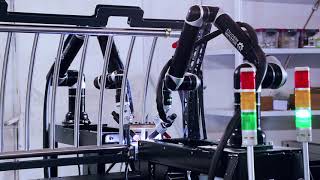
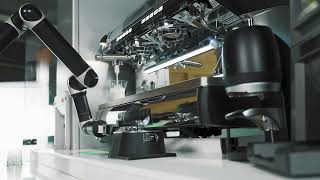
Image/s credit: Rozum Robotics.

Rozum Robotics RC Series Cobots

company logo for Rozum Robotics Rozum Robotics

Country: Belarus

Year: 2023

Summary

A versatile series of 6-axis collaborative robot arms offering 5–10 kg rated payloads and up to 1,300 mm reach for industrial automation, research, and education.

Status: Commercially available

Operation: Semi-autonomous, Collaborative, Tethered

Robot Type / Domain: Multi/General-Purpose, Research, Industrial, Educational

Tasks: Pick & Place, Machine Tending, Assembly, Packaging & Palletizing, Welding, Painting & Dispensing, Gluing & Sealing, Quality Control & Inspection

Technical Specifications (series range)

Reach: 915 to 1300 mm

Reach: 36.024 to 51.181 in

Payload: 6 to 12 kg

Payload: 13.228 to 26.455 lbs

Pose Repeatability: ± 0.5 mm

Pose Repeatability: ± 0.020 in

Weight: 27 to 38 kg

Weight: 59.525 to 83.776 lbs

Battery Operated? No, Tethered

Arm Type: Articulated, Collaborative

Number of Axes: 6 DoF

IP Rating: IP54

Mounting: Floor, Ceiling, Wall, Any desired angle

Footprint: N/A

Operating Temperature: N/A

TCP Speed: 2 m/s max.

Compatible Tools: Can be integrated with suitable grippers, welding tools, lasers, cameras and other end effectors

Software: PULSE graphical programming software and Python API | Hand-guided trajectory teaching is supported

Controller & Computing: Dedicated robot controller supplied with the robot

Actuators: Rozum-developed servo motors integrated into the joints

Power Consumption: 90 to 1300 W

Certification: Tool Flange ISO 9409-1-50-4-M6

No more specs to show.

Top 5+ Qualities (by addoobot)

What we find to be the top qualities of the Rozum Robotics RC Series Cobots:

  • Two Payload and Reach Options: Choose between the smaller RC5 and the longer-reaching, higher-payload RC10.
  • In-House Motion Technology: Rozum uses its own servo-motor technology within the robot joints.
  • Visual and Code-Based Programming: PULSE software supports visual programming, while the Python API provides more advanced control options.
  • Easy Trajectory Teaching: Operators can guide the arm by hand when setting up or adjusting robot movements.
  • Six-Axis Movement: Both models use six articulated axes to reach and orient tools across a wide working area.
  • Flexible Integration: Compact bases and multiple mounting possibilities help the arms fit into existing work areas and mobile installations.
  • Versatile Tool Compatibility: The standard ISO tool flange supports integration with suitable grippers, welding equipment, cameras and other end effectors.
  • Collaborative Design: The series is designed to operate alongside people, subject to proper integration and a task-specific safety assessment.

More Videos

Play video background image - video 2
Example Application: Welding Robots by Rozum Robotics
Play video background image - video 2
Example Application: Coffee Making
Play video background image - video 2
Robotic Barista by Rozum Robotics' Cobots

Learn More

Applications

The RC Series is designed mainly for repetitive workflows where the robot needs to reproduce the same motion consistently. Rozum Robotics highlights pick-and-place, machine tending, painting, injection moulding, laboratory testing, welding, gluing, quality control, and polishing/deburring as applications for the platform. The company also lists packaging, palletising, assembly, screwdriving, sealant application and conveyor-related operations.

This makes the RC family suitable for a broad range of manufacturing environments rather than one specialised process. The RC5 can make sense where objects are relatively light and available workspace is smaller, while the RC10 provides additional payload and substantially greater reach for larger work areas or heavier parts. Tooling can also be changed according to the task, allowing the arm to work with grippers, welding equipment and other compatible end effectors.

Research laboratories and educational institutions are also explicitly identified as target users, giving the RC platform relevance outside conventional production automation.

Programming, Integration & Collaborative Operation

Rozum Robotics has designed the RC Series around relatively straightforward deployment. Operators can teach motions through hand guiding, while the PULSE programming system provides a graphical approach to configuring robot tasks. Developers who need more control can instead access the robot through a Python API.

The robots can also be mounted in several orientations, including on a work surface, wall or ceiling, or incorporated into a mobile installation, which makes it easier to adapt them to existing production layouts. Their ISO-standard tooling flange provides another useful integration feature because different end effectors can be fitted according to the application.

Rozum describes the RC models as collaborative robots and states conformity with ISO/TS 15066:2016. However, collaborative capability does not automatically mean that every completed application can operate without guarding. ISO describes collaborative safety at the robot-system and workspace level, so the final tooling, workpiece, speeds and application still need to be considered when implementing a collaborative workspace.

RC5 vs RC10 – Which Model Fits What

The biggest differences between the two officially listed Rozum RC models are payload, reach and robot weight. Both use six axes, have the same listed ±0.5 mm repeatability, IP54 protection and maximum TCP speed of 2 m/s.

Model: RC5
Rated Payload: 5 kg | Max. Payload: 6 kg | Reach: 915 mm | Robot Weight: 27 kg | Repeatability: ±0.5 mm | Max. TCP Speed: 2 m/s | IP Rating: IP54
Best suited for: Lighter pick-and-place, machine tending, dispensing, screwdriving, inspection, laboratory work, assembly, and other tasks where 5 kg rated payload and a smaller working envelope are sufficient.

Model: RC10
Rated Payload: 10 kg | Max. Payload: 12 kg | Reach: 1,300 mm | Robot Weight: 38 kg | Repeatability: ±0.5 mm | Max. TCP Speed: 2 m/s | IP Rating: IP54
Best suited for: Heavier part handling, larger machine-tending cells, welding, palletising, packaging, and applications requiring substantially greater reach or payload capacity. In simple terms, RC5 is the more compact lighter-duty choice, while RC10 prioritises payload and working range.

Please visit the official website for more accurate, up-to-date, and complete information on this post. Visit Website   External Link Icon

Disclaimer: For informational purposes only. The provided data and/or content are intended as references and may contain errors. We appreciate your help in maintaining accuracy; if you spot any errors, please notify us. For the most reliable and up-to-date information, kindly refer to the official website. By using addoobot and its contents and services, you agree to our Terms and Conditions, Privacy Policy, and Cookie Policy.

Thumbs Down Icon Thumbs Up Icon
0 1 2 3 4 5 6 7 8 9 10

Select appealing qualities


 0 Comments

Sign in to comment, reply, and more

No Comments Yet

Be the first to share your thoughts!