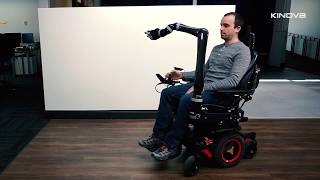
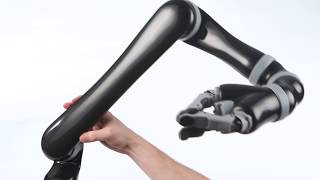
Image/s credit: Kinova.

Kinova Jaco Assistive Robotic Arm

company logo for Kinova Kinova

Country: Canada

Year: 2009

Summary

A wheelchair-mounted, six-axis assistive robotic arm that helps people with limited upper-body mobility reach, grasp and manipulate everyday objects more independently.

Status: Commercially available

Operation: Teleoperation, Collaborative, Tethered

Robot Type / Domain: Assistive, Medical & Healthcare

Tasks: Eating & Drinking, Personal Hygiene, Medication Management, Work & School, Leisure, Object Handling, Personal Safety

Technical Specifications

Max. Reach: 900 mm

Max. Reach: 35.433 in

Payload: 1.3 kg

Payload: 2.866 lbs

Max. Payload: 1.6 kg

Max. Payload: 3.527 lbs

Pose Repeatability: N/A

Weight: 5.2 kg

Weight: 11.464 lbs

Battery Operated? Tether & battery

Arm Type: Articulated, Collaborative, Assistive

Number of Axes: 6 DoF

IP Rating: N/A

Mounting: Other

Footprint: N/A

Operating Temperature: -10 ℃ to 40 ℃

Operating Temperature: 14.000 ℉ to 104.000 ℉

Speed: 20 cm/s Max.

Protection Rating: IPX2

Control Interfaces & Modes: Powered-wheelchair joystick, Kinova joystick, head array, sip-and-puff control and other compatible accessible inputs. | Modes: Translation, wrist orientation, drinking and finger control.

Software: Kinova’s Assistive Robotic Arm Configurator is used by the installer to map controls, set speed limits, establish protection zones and configure Home and Retract positions.

Material: Carbon fiber, aluminum

Power supply: 18 to 29 VDC

Power Consumption: 25 W during normal operation, 5 W in standby and 100 W peak.

No more specs to show.

Top 5+ Qualities (by addoobot)

What we find to be the top qualities of the Kinova Jaco assistive robot arm:

  • Focused on Everyday Independence: Jaco helps users perform meaningful daily activities that might otherwise require assistance from another person.
  • Accessible Control Options: It can work with wheelchair joysticks, head arrays, sip-and-puff controls and other interfaces suited to the individual user.
  • Human-Like Six-Axis Movement: Shoulder-, elbow- and wrist-like joints provide flexible positioning around the user and wheelchair.
  • Useful Three-Finger Gripper: The 40 N gripper can hold and manipulate many common household, school and workplace objects.
  • Specialised Drinking Mode: A dedicated control mode changes the wrist’s rotation point to support drinking from a glass or bottle.
  • Lightweight Construction: Carbon-fibre links help keep the total arm weight close to 5.2–5.4 kg despite its 900 mm reach.
  • Wheelchair-Integrated Power: Jaco runs from the powered wheelchair’s battery, avoiding a separate portable power system.
  • Compact Retracted Position: A configurable Retract position reduces the space occupied by the arm when it is not being used.
  • Personalised Installation: Controls, speed limits, protection zones and preset positions are configured for the user’s wheelchair, equipment and needs.
  • Low Average Power Use: Approximately 25 W average consumption helps limit the additional demand placed on the wheelchair battery.

More Videos

Play video background image - video 2
JACO to Help With Meals
Play video background image - video 2
JACO's Arm Movement
Play video background image - video 2
Amazing Control of the JACO Robot Arm

Learn More

A Robot Built Around Everyday Independence

Jaco was not created primarily to assemble products, tend machines or serve as an open research manipulator. Kinova defines it as a medical assistive device for people with functional limitations or upper-body disabilities, designed to be installed directly onto a powered wheelchair.

The idea is straightforward: provide the user with an additional robotic arm that can reach, grasp and manipulate objects that might otherwise require help from another person. Kinova identifies applications including eating and drinking, personal hygiene, medication management, leisure, work and school, and personal safety.

The user remains in control. Rather than requiring conventional robot programming, Jaco can be mapped to accessible control hardware suited to the individual. Its Cartesian control system means the user can command the hand to move left, right, forward, backward, up or down while Jaco's internal kinematics coordinate the individual joints. The three-finger gripper then provides direct control over grasping and releasing objects.

Designed Around the User and the Wheelchair

A major strength of Jaco is that the robot, wheelchair and control system are configured as one assistive setup. Kinova says the arm can be integrated with a wide variety of powered wheelchairs, while the final installation is performed by an approved technician and customised to the user's equipment and requirements.

During setup, the technician can configure safety limits, no-go zones around the user's body, control mappings, and home and retract positions. This is important because Jaco operates very close to its user throughout the day rather than inside a separated industrial robot cell.

The available control options also reflect this user-centred approach. Depending on the wheelchair and individual setup, Jaco can be operated using a joystick, head controls, sip-and-puff input or other accessible interfaces. An optional lift arm can further expand the useful workspace by tilting the mounting system forward to improve access to lower objects.

Jaco vs Other Kinova Robot Arms

Jaco stands apart from Kinova’s other robotic arms because it was developed specifically as an assistive device for everyday use rather than as a research or industrial automation platform. In fact, Jaco is closely tied to Kinova’s origins in assistive robotics, with later platforms such as Gen2, Gen3 and Gen3 lite expanding the company’s technology into professional, research and educational applications, while Link 6 moved further into industrial collaborative automation. More recently, Kinova has also expanded into medical robotics with platforms such as KIMA. So while Jaco shares Kinova’s broader lightweight robotic-arm heritage, its purpose remains distinct: helping people with upper-body mobility limitations gain greater independence in daily activities.

DO NOT COPY

Do Not Copy

Please visit the official website for more accurate, up-to-date, and complete information on this post. Visit Website   External Link Icon Specifications   External Link Icon

Disclaimer: For informational purposes only. The provided data and/or content are intended as references and may contain errors. We appreciate your help in maintaining accuracy; if you spot any errors, please notify us. For the most reliable and up-to-date information, kindly refer to the official website. By using addoobot and its contents and services, you agree to our Terms and Conditions, Privacy Policy, and Cookie Policy.

Thumbs Down Icon Thumbs Up Icon
0 1 2 3 4 5 6 7 8 9 10

Select appealing qualities


 0 Comments

Sign in to comment, reply, and more

No Comments Yet

Be the first to share your thoughts!