Built for Robotics Research and Development
The Gen3 sits between a conventional industrial robot and an open research platform. Its lightweight carbon-fibre and aluminium construction makes it easy to move between laboratories, workstations and mobile robots, while its integrated controller avoids the need for a large external control cabinet. More importantly, Kinova gives developers access to both convenient high-level commands and 1 kHz low-level control.
Torque sensors are integrated into the actuators, allowing researchers to work with force-aware control, compliant motion, collision response, haptic interaction and physical human–robot interaction. Users can program the arm through Kortex, ROS, ROS 2, C++, Python or MATLAB and develop applications in simulation using Gazebo and MoveIt.
The optional wrist-mounted colour and depth sensors add perception without requiring a completely separate camera installation. Together, these features make Gen3 particularly useful when the objective is to develop and test new robotics capabilities rather than purchase a narrowly defined turnkey automation cell.
Applications and Integration
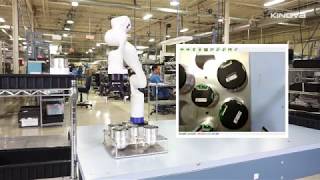
Gen3 can support handling, pick-and-place, dexterous assembly, vision-guided manipulation, inspection, laboratory automation and robot-learning experiments. It is especially well suited to mobile manipulators because the arm is light, has an embedded controller, consumes relatively little power and can be connected to an external battery system.
For human–robot interaction research, the joint torque sensors and low-level control access allow developers to investigate hand-guiding, compliance, haptic feedback, teleoperation and collision-responsive behaviours. The 7DoF version is particularly valuable when the robot must reposition its elbow while maintaining the same end-effector pose, such as when moving through cluttered spaces or working near people.
Gen3 should nevertheless be understood as a configurable platform. The gripper, perception system, application software and overall safety architecture depend on the selected integration. Its collaborative design does not remove the need for an application-specific risk assessment, suitable tooling and any safeguarding required by the completed system.
Choosing the Right Gen3 and Kinova Robot
The two Gen3 models have the same published payload and speed, so the decision mainly concerns kinematics, weight, reach and repeatability. The 6DoF model is lighter and has substantially better published repeatability. The 7DoF model adds one redundant joint, allowing the arm to change its posture or elbow position while preserving the tool pose.
Model: Kinova Gen3 6DoF
Payload: 2 kg full-range continuous | Mid-range continuous payload: 4 kg | Reach: 891 mm | Robot Weight: 7.2 kg | Repeatability: 0.1 mm | IP Rating: IP33
Best suited for: Lightweight manipulation, robotics research, mobile robotics and applications where six axes provide sufficient freedom of movement.
Model: Kinova Gen3 7DoF
Payload: 2 kg full-range continuous | Mid-range continuous payload: 4 kg | Reach: 902 mm | Robot Weight: 8.2 kg | Repeatability: 1.0 mm | IP Rating: IP33
Best suited for: Advanced manipulation, human–robot interaction and research applications that benefit from the additional redundancy and posture flexibility of a seventh axis.
Gen3 vs Other Kinova Robot Arms
Kinova's robotic-arm range spans research, professional, industrial and assistive applications. The Gen3 sits primarily as an advanced research and development platform, but it is useful to understand how it differs from Kinova's Gen3 lite, Gen2, Link 6 and Jaco arms.
Gen3 lite is the smaller and more accessible member of the Gen3 family. It uses a 6-axis configuration and is aimed particularly at education and research, where users may not need the higher payload, richer sensing and additional configuration options of the full Gen3. Both platforms use Kinova's Kortex ecosystem, but Gen3 provides the more capable platform for advanced robotics research.
Gen2 is Kinova's earlier ultra-lightweight professional and research robot platform. Like Gen3, it is available in 6- and 7-axis configurations and was designed to be portable and power-efficient, with an embedded controller. Gen3 represents the newer generation of Kinova's lightweight research arms, adding the Kortex control platform, more advanced sensing and other capabilities intended for modern robotics research and development. Gen2 nevertheless remains listed by Kinova for professional, medical, educational and robotics-research applications.
Link 6 takes Kinova in a more industrial direction. Rather than being primarily a lightweight research manipulator, Link 6 is Kinova's industrial collaborative robot, designed for automation applications that require greater payload, reach, speed and industrial integration. In simple terms, Gen3 is better viewed as Kinova's advanced lightweight research platform, while Link 6 is the company's production-oriented industrial cobot.
Jaco is different again. It is an assistive robotic arm, not a general-purpose research or industrial cobot. Kinova designed Jaco to mount to a powered wheelchair and help users perform everyday activities more independently. It can be controlled through interfaces such as the wheelchair joystick, head array or sip-and-puff controls. Jaco is also historically important to Kinova: the company identifies it as its first robotic arm and the product around which Kinova's origins in assistive robotics were built.
A simple way to understand Kinova's main robot arms is:
Jaco → assistive robotic arm for everyday independence
Gen2 → earlier-generation lightweight professional and research platform
Gen3 lite → compact and accessible education/research platform
Gen3 → advanced lightweight research and development platform
Link 6 → industrial collaborative robot for automation
 Research
  Industrial
  Consumer
  Social
  Service
  Assistive
  Medical & Healthcare
  Emergency Response
  Building & Construction
  Other Infrastructure
  Transport
  Arts & Entertainment
  Agriculture & Forestry
  Law & Order / Security
  Other
Other 
 Kinova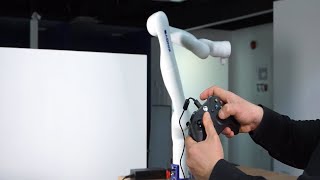


 Multi/General-Purpose Robots
  View All
  Linkedin
 in Sydney, Australia.
Share